
content
Chess has a position with a German name, zugzwang. Every available move makes things worse, and the player would happily pass, but the rules say you must move. The weeks before Black Friday feel much the same to a shop owner, with one pleasant difference.
In advertising, you are allowed to pass.
Pre-sale checklists never mention this. They are lists of things to do on your site and in your Google Ads account, and each one promises sales if you get it done in time. Yet some of the most popular tips are Black Friday marketing mistakes in disguise, and they work against profit. You can see it in the data, Google’s own documentation and regulators’ decisions, if you read them without the festive mood.
Below are 4 moves worth skipping. The first 3 are ordered by time, from 5 minutes to an evening, and the fourth takes 15 minutes now but only pays off in February. Each block stands alone, so start with the one you have time for.
Don’t switch on a seasonality adjustment
This move takes 5 minutes, because there is nothing to do. If your Google Ads account already has a seasonality adjustment set for the sale days, remove it. If it doesn’t, leave it that way.
A seasonality adjustment is a Smart Bidding setting that lets an advertiser tell the algorithm in advance how much the conversion rate will change on certain days. The algorithm raises or lowers bids in response.
The advice to switch it on before a sale appears in almost every roundup, and it has a logic to it. Conversion rates rise on Black Friday, the algorithm “doesn’t know”, so you had better tell it.
Google’s own help page disagrees. “Use seasonality adjustments only if you expect major changes to conversion rates, because Smart Bidding already manages seasonal events,” it says. The same page adds that adjustments “are ideal for short events of 1-7 days”. Black Friday isn’t mentioned there, but it arrives at the same point every year, which makes it the least surprising event on the algorithm’s calendar.
Optmyzr measured what happens when advertisers tell it anyway. The company analysed up to 6,000 ad accounts a year across 3 seasons, 2022 to 2024, comparing the 8 days around Black Friday with the week before.
In accounts without an adjustment, cost per click rose 16-17% and ROAS moved between -2% and +5.7%. In accounts with one, clicks got 32-37% dearer and ROAS fell 10-17%.
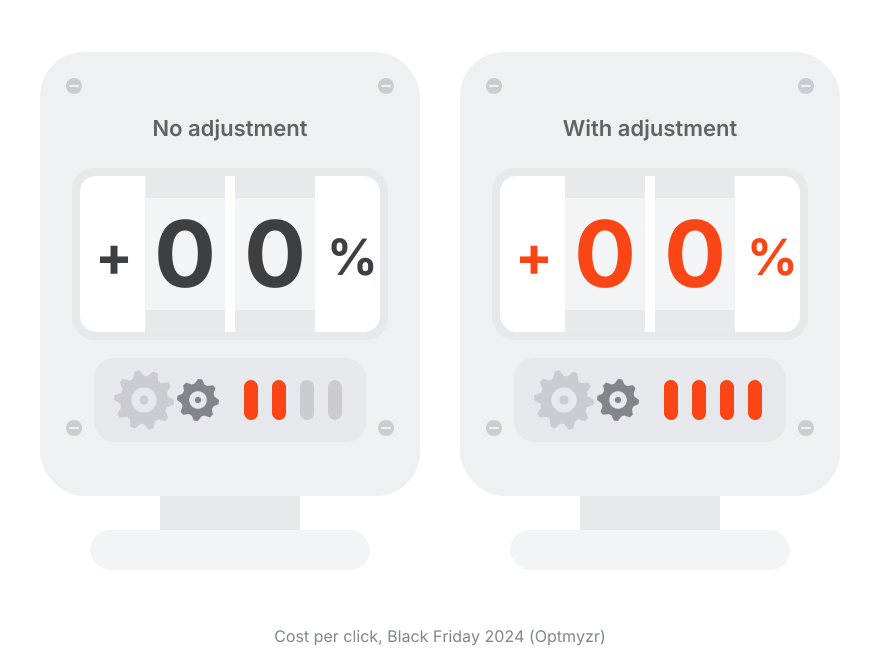
An adjustment is a forecast, and the algorithm treats it as fact. “Smart Bidding takes this literally. It does not hedge your bet. It assumes you have perfect foresight,” explains Fred Vallaeys, co-founder and CEO of Optmyzr.
Say an advertiser promises a 40% lift in conversion rate and gets 15%. The algorithm overpays for the gap in every auction. It behaves like an intern on day one. Tell it there will be 3 times as many orders, and it buys 3 times as many boxes.
Revenue did grow noticeably faster in adjusted accounts in 2022 and 2023, because the algorithm bought more sales at a higher price. By 2024 that advantage had almost gone. If all you want from the season is volume at any cost, the adjustment will deliver it.
The tool still earns its place for events nobody can see coming. A one-day flash sale in March or a big email push to your whole list is exactly the case where Google has no history and can’t predict the spike.
Optmyzr sells ad management software and compared 2 groups of accounts, with no controlled experiment. Part of the gap may come from the advertisers themselves, since those who set adjustments tend to push for volume.
Black Friday is no surprise to Google. If you want profit from the sale, take the seasonality adjustment off for those days and save it for promotions the algorithm has no way of knowing about.
Don’t strike through a price that never was
An hour of checking that pays for itself faster than anything else here. Open your price history and compare it with what will sit in the strikethrough line. If the numbers don’t match, show the earlier price you did charge, or don’t claim a percentage discount at all.
A strikethrough price looks like decoration. To a regulator it is a claim that can be checked, and each market checks it differently.
| Who checks | What they require |
|---|---|
| EU | The prior price is the lowest price over at least 30 days before the reduction starts |
| Australia | A discount claim must not mislead, including words such as “sitewide” and “was/now” |
| US, federal level | The former price was offered regularly and for a reasonably long time, with no set number of days |
| Google Merchant Center | The base price was charged for 30 of the past 200 days, and the discount is more than 5% and less than 90% |
In the EU the rule sits in Article 6a of the Price Indication Directive. A price reduction has to show the prior price, defined as the lowest price in at least 30 days before the reduction began. Removing the strikethrough line and keeping “-20%” won’t help, because the breach remains.
In March 2026 the European Commission published the results of a sweep of Black Friday and Cyber Monday sales. Consumer authorities in 23 EU member states, Iceland and Norway checked 314 online traders, and 30% of them displayed discounts incorrectly.
“Businesses should know that we are monitoring and have successfully taken traders to court for fake discounts,” warned Helen Martin, Member of Ireland’s Competition and Consumer Protection Commission.
Tied to this rule is a move you needed to make a month ago. The 30 days are counted back from the start of your reduction. If the sale opens on the Friday itself, the window opens in late October. If you run a full Black Week or a Black November, it opens earlier still.
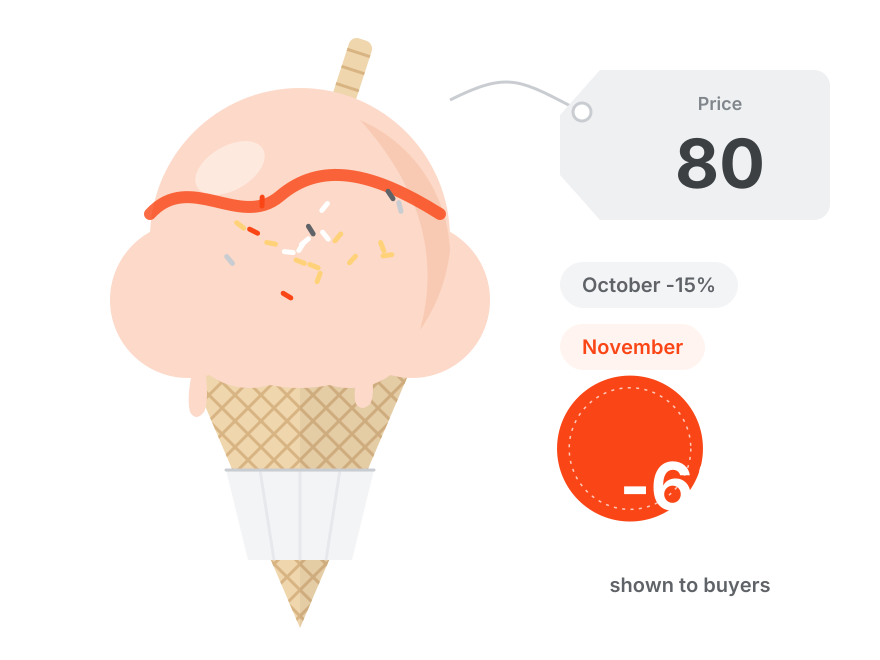
Anyone who ran a 15% “warm-up” inside that window has set a new prior price for themselves. A November discount of 20% off the original price can now be shown as just under 6%.
The October promo ate the November one.
A warm-up that ended before the window opened does no harm. Some EU countries also let you count from the original price when a discount keeps growing without a break, so check the rules where you sell.
Australia’s regulator, the ACCC, looks at the claim as a whole. In June 2025 it announced that Michael Hill, MyHouse and Hairhouse Online had each paid an A$19,800 infringement notice over allegedly misleading Black Friday advertising. All 3 promoted “sitewide” discounts, and at Hairhouse more than a quarter of products were not part of the sale. Paying the penalty is not an admission of a breach.
“Advertisements that talk about ‘sitewide’ or ‘storewide’ sales or promise discounts ‘off everything’ should deliver what customers expect, and not be used by retailers to hook consumers under false pretences,” said ACCC Deputy Chair Catriona Lowe.
An asterisk and some small print won’t save you here.
The US has no set number of days at federal level. Under the FTC’s Guides Against Deceptive Pricing, a former price is genuine when the item was “offered to the public on a regular basis for a reasonably substantial period of time”. State laws can be stricter.
Google is the least patient of the lot, because it doesn’t wait for complaints. The sale badge in Shopping usually appears only when the base price was charged for 30 of the past 200 days (in the US, 5 of the past 30 or 15 of the past 200), and the discount is more than 5% and less than 90%. A price raised a week before the sale has no such history.
Consumer groups do the maths for shoppers. In the UK, Which? tracked 227 products from Black Friday 2023 deals at 8 major retailers, and 92% were the same price or cheaper at other times of the year.
“Our investigation is a reminder to shoppers that they should not feel pressured to splash out on Black Friday purchases,” said Harry Rose, Editor of Which? Magazine, adding that those deals are usually repeated or beaten at other times of the year.
The sale page also needed attention well in advance. “Use a recurring URL, not a new URL for each occurrence of the event,” Google’s Alan Kent advised on the Search Central blog back in 2020. In ecommerce SEO, a new address every year means the search engine meets the page at the very moment it should already be bringing in buyers.
You need to be able to back the prior price next to a discount with your price history. In the EU it is the lowest price over at least 30 days before the reduction starts. If you can’t back it, the safer option is to state the new price with no percentage.
Don’t offer a discount you haven’t costed
You’ll need an evening and a calculator. A discount that fails a simple sum is better made smaller or swapped for something else.
Take a product priced at 100 with 40 of margin. A 20% discount takes 20 off the price, and all of it comes out of the margin, because the cost of goods hasn’t changed. Profit per unit drops from 40 to 20. To make the same profit you have to sell twice as many units.
At 30% off, 10 per unit is left, and you need to sell 4 times as many.
For any other numbers, divide the margin by the margin minus the discount. The table shows how many times unit sales must grow.
| Discount | 30% margin | 40% margin | 50% margin |
|---|---|---|---|
| 10% | 1.5 times | 1.33 times | 1.25 times |
| 20% | 3 times | 2 times | 1.67 times |
| 30% | no profit left | 4 times | 2.5 times |
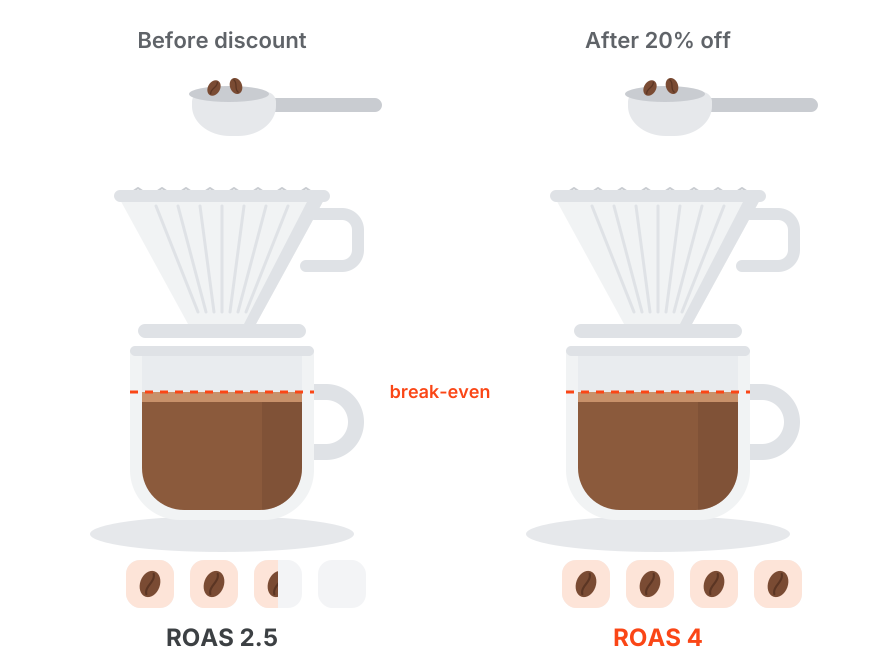
Advertising reacts to a discount even more sharply. Before it, a campaign broke even at a ROAS of 2.5, because every 100 of revenue carried 40 of margin. After a 20% discount, every 80 of revenue carries 20, and break-even ROAS climbs to 4.
A campaign running at a ROAS of 3 was making money before the discount. At the same ROAS of 3 after it, the campaign loses money, and the report won’t warn you.
More expensive clicks come on top. Optmyzr found CPC rising 16-17% around the sale even in accounts with no adjustments, while the lift in conversion rate shrank every year from 2022 to 2024, from 17.5% to 7.5%. Smarter Ecommerce, across nearly 2,000 European accounts, measured Black Friday 2025 against the year before and found CPC up 24%, buying intent up 16% and average order value down 6.6%.
Around this time, Google Ads recommendations start suggesting you raise budgets and change your target ROAS for the expected rise in traffic. The advice makes sense once you remember who is giving it.
Instead of discounting everything, you can discount only high-margin products, swap the percentage for a gift or free shipping above a set order value, or settle for 10% where you wanted 30.
In the ad account, pass conversion values based on margin, or move sale products into a separate campaign with a target ROAS above the new break-even. Raising target ROAS across the whole account is simpler, but it cuts impressions on the very days when buyers are most plentiful.
The sum is simplified. It assumes the discount applies to every unit sold, and it leaves out ad cost per sale, repeat purchases and stock that is cheaper to sell than to store. Where prices include VAT or GST, the break-even figure only holds if conversion values are passed excluding tax.
If a discount doesn’t add up even in this form, a more complex model rarely rescues it.
The lower your margin, the more each percentage point of discount costs. Before the sale, find your row in the table and recalculate your break-even ROAS, and only then choose the percentage.
Don’t count all new customers the same
Today this move takes 15 minutes, and the answer arrives in February. Tag the customers who came for the sale as their own group, and don’t judge them by the same acquisition cost as October’s.
Black Friday brings in a lot of new people, and in the report that looks like a win. The question is how many of them will come back.
Some of them are like wedding guests who came for the buffet.
In a blog post, Airship looked at more than 60 million new shopping app installs between 1 October and 27 November 2023. Installs on Black Friday were double the average October day, but the advantage didn’t last. The company found that “peak-week customers go on to average 18% lower weekly retention rates than customers acquired pre-holiday”.
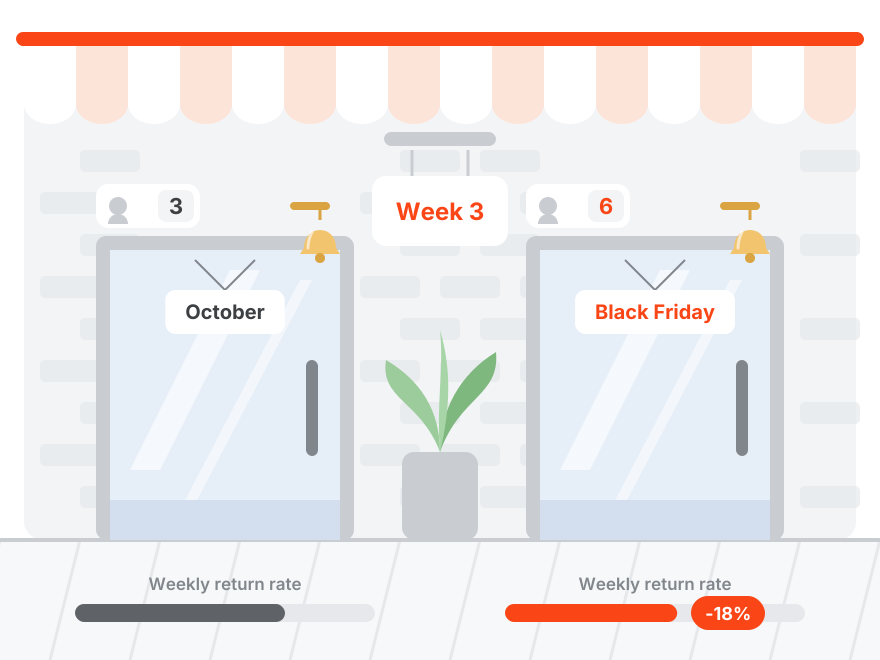
The data covers apps, is a few years old, and comes from a marketing platform vendor. Apply it to your own shop with care, though the direction is easy to test on your own numbers.
A Black Friday click is among the most expensive of the year, so a sale customer has to stay longer to pay back. Brands “must hold on to newly acquired customers for dear life,” write Forrester analysts in a report Airship quotes.
In 15 minutes you can tag sale-period orders in your CRM or analytics, so that in February you can compare this group’s repeat purchases with a normal one.
Google Ads has a new customer acquisition goal for this. Its modes include bidding higher for new customers and bidding for new customers only. It recognises existing customers mainly from a customer list and a tag that you set up yourself.
If February shows that sale customers come back noticeably less often, you can pay less for them next November.
Some orders will come back. According to a report by the NRF and Happy Returns, US retailers expected 15.8% of annual sales to be returned in 2025, and 17% of holiday sales. Google Ads knows nothing about this until you send it conversion adjustments. “Retract conversions that should no longer be counted,” its help page advises. Without that, the sale’s ROAS in the report will look better than it does in your books.
A new customer from the sale and a new customer from an ordinary week behave differently. Tag the November group now, check it in February, and count sale revenue only after the returns window has closed.
Whoever doesn’t have to move wins
In zugzwang, the player who has to move loses. Before Black Friday that turn seems to belong to everyone, and most shops dutifully make every move on the checklist.
Avoiding these 4 Black Friday marketing mistakes takes less than a day and needs no budget.
The rest of the work goes into the calendar. In February, open the November customer group and see how many came back. Next October, before the 30-day window opens, fix your prices and resist the warm-up. The sale page stays where it is the whole time, at the same address.
If the sale is weeks away and you have no time to check, talk to Advantrise. We’ll go through your campaigns, feed and sale page and tell you which moves you in particular should skip.
The closer it gets to Friday, the more both the click and the mistake cost. Competitors running an adjustment overpay in every auction and push up prices for everyone bidding beside them.
FAQ about Black Friday marketing mistakes
When should you start preparing for Black Friday?
At least a month ahead. In the EU the prior price is set by the 30 days before your reduction starts, and Google wants the sale page ready earlier still. “Make sure you create the page well before the sale so Googlebot has time to discover and index the page,” says the Google Search Central blog. If the month has already gone, avoiding mistakes is worth more than catching up.
Should you use a seasonality adjustment for Black Friday?
For Black Friday, mostly no. Google Ads Help says to use one only when you expect major changes to conversion rates, because Smart Bidding already manages seasonal events, and in Optmyzr’s analysis accounts with an adjustment lost 10-17% of ROAS. It suits unexpected short promotions the algorithm has no history for.
How big should a Black Friday discount be?
As big as the sum allows. Divide your margin by your margin minus the discount to see how many times unit sales must grow. At a 40% margin and 20% off that is 2 times the unit sales, and at 30% off it is already 4.
Can you show a strikethrough price in a Black Friday sale?
Yes, if you can back it up. In the EU it must be the lowest price over at least 30 days before the reduction starts. In Australia and the US, regulators judge whether the claim misleads, and Google Shopping shows the sale badge only when the base price has a history.
Should a small business do Black Friday?
Not necessarily with a discount on everything. If the sum doesn’t work, a small discount on high-margin products or a gift with the order is the smarter choice. Clicks cost more for everyone on these days, and without spare margin you feel it straight away.
Subscribe to our newsletter