
content
Most ecommerce SEO plans start with good intentions and end with an endless backlog. You open a list of categories and think you should optimize everything. Or you read a few guides and pick topics based on gut feeling. Both approaches sound reasonable until you hit the real constraints: limited time, slow feedback loops, and competitors who have been building organic visibility for years.
The good news is you may already have the best decision-making tool for SEO priorities: your PPC account. Paid search is not just a traffic source. It is a live lab that reveals demand, intent, messaging, and what actually converts. Using this data to guide eCommerce SEO priorities is one of the fastest ways to close the gap between what you rank for and what actually brings revenue. It is a live lab that reveals demand, intent, messaging, and what actually converts. At Advantrise, we often use paid search data to help small and mid-sized stores stop guessing and start building SEO pages with clear business potential.
Why PPC data beats intuition for choosing SEO topics
SEO can feel like betting on the future. You invest time into a page and hope it earns its place in search results. PPC, by contrast, gives faster signals. You see which queries people use, which ads they click, and which landing pages lead to purchases. That is not the full story, but it is a strong filter for deciding what deserves your SEO attention first.
This does not mean that anything that works in Google Ads will automatically rank organically. Some paid wins are driven by budget, targeting, or short-term promotions. But PPC data is still one of the most practical forms of keyword research for ecommerce: it shows how people describe their needs and how close they are to buying.
Here is what paid search can reliably teach your SEO strategy when you read it the right way:
- Demand: which product themes people actively search for (and how they phrase it).
- Intent: whether the query sounds like buying, comparing, or learning.
- Page performance: which category or product pages turn visits into orders.
- Seasonality: what spikes in Q4, what returns in Q1, and what stays stable year-round.
Step 0: make sure your site is not leaking value
Before you translate PPC insights into SEO priorities, make sure your site foundation is not working against you. If search engines are crawling thousands of low-value URLs, or if core categories are weak, your best topic choices will still struggle to grow.
You do not need a heavy technical review to start. A quick ecommerce SEO audit is often enough to catch the common leaks: index bloat, duplicate pages, broken links, and category pages that are missing trust signals like shipping, returns, and clear product selection. Fixing these basics first makes every SEO improvement easier to measure and easier to scale.

Step 1: extract what SEO actually needs from PPC
The fastest way to get lost is to read PPC data through the lens of campaigns and ad groups. For SEO, that view is rarely useful. SEO needs themes, intent, and page roles. So the goal is to turn paid search signals into a clean set of topic clusters and page types.
Start with search terms. Look at how people describe the problem, not just the keyword itself. One word can change the intent: “buy” and “price” tend to signal a shopping mindset, while “best” and “vs” often signal comparison. Then look at where traffic lands and what converts. If a certain category page consistently performs well in paid search, it is usually a good candidate for an SEO priority page.
Finally, capture seasonality. PPC often reveals patterns that keyword tools hide: the weeks when a category becomes expensive, the months when demand softens, and the moments when shoppers shift from browsing to buying.
Step 2: a simple prioritization score you can explain to a business owner
You do not need complex scoring models to make better decisions. You need a short checklist that focuses on revenue potential and structural clarity. If a topic fails the basics, it should not become a top SEO priority yet.
A topic is a strong SEO candidate when it checks most of these boxes:
- It shows consistent demand in PPC, not just a one-week spike.
- It matches commercial intent or sits close to it (shopping or high-value comparison).
- It leads to products with healthy margin or strategic value.
- It can live as one clear primary URL on your site (not three competing pages).
- The landing experience is strong: filters, inventory depth, trust signals, and a clean path to checkout.
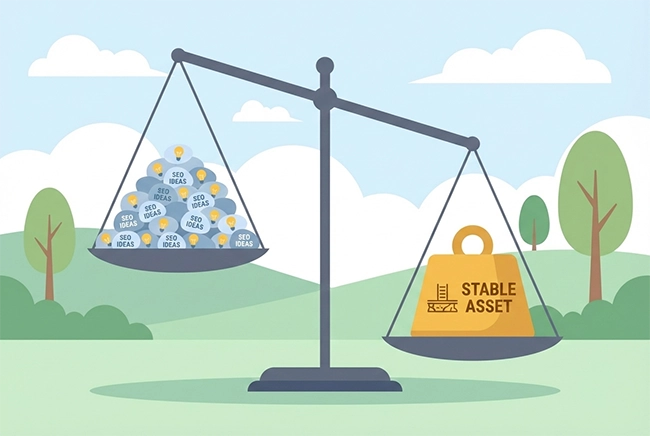
This is the difference between “SEO ideas” and an ecommerce SEO strategy. You are not collecting topics. You are choosing pages that can become stable assets for search marketing over time.
Step 3: turn PPC insights into the right SEO page type
Once a topic is a priority, the next decision is the page format. Many ecommerce sites lose months by creating the wrong type of page for the intent. PPC helps here because it reveals what the shopper expects after the click.
If the query suggests shopping, your primary SEO target is usually a category or subcategory page. That page should be built for selection and purchase: good filtering, clear messaging, and confidence-building details. If the query suggests learning or comparison, a guide can be the right asset but it should support the buying journey, not replace it. A guide that ranks but never routes users into the catalog is often a missed opportunity.
For narrow, specific intent, a subcategory or curated collection can make sense. The key is to avoid duplicates. If a collection is just a re-labeled category with the same products, it will compete with your main category and create instability instead of growth.
Step 4: avoid keyword cannibalization when you create new pages
This is the part that surprises people: you can choose the right topic and still get worse results if you create an extra page that competes with an existing one. That is keyword cannibalization, and ecommerce sites are especially prone to it because they have categories, collections, blog posts, and filter-generated URLs.
The practical rule is simple: one topic should have one primary URL. Decide which page is the main destination for that theme. Everything else either supports it, answers a different intent, or stays navigation-only. Your internal links should reinforce that decision. Menus, breadcrumbs, and “related” blocks are not just UX. They are signals about what you consider most important.
If you already see rankings bouncing between two URLs for the same query cluster, it is usually a sign you need to clarify roles, not publish more pages.

Step 5: how to validate your SEO priorities without chasing one magic metric
It is tempting to look for one number that proves your plan works. In practice, SEO progress shows up as patterns: more visibility for the theme, more stable rankings, and better alignment between what searchers want and where they land.
Use simple checks. Are impressions and clicks rising for the priority page cluster? Are you capturing more variations of the query over time? Do users land on pages that actually help them buy, rather than bouncing between similar URLs? When SEO and PPC work together, you also tend to see a strategic effect: paid search becomes less dependent on expensive coverage for the same intent because organic demand starts getting captured on its own.
A short, realistic example: when PPC helped SEO find the right anchor page
Imagine a small home goods store serving one primary market with a limited budget. Paid search showed consistent demand for a specific product theme, but organic traffic was unstable. Some weeks Google sent users to a category page, other weeks to a collection, and sometimes to a blog post. No single page became a reliable performer.
The fix was not to publish yet another page. The team picked one category as the anchor page for the theme. The collection was reshaped into a narrower subcategory so it stopped duplicating the main page. The blog post stayed, but its role changed: it became a guide that points users to the category and helps them choose. At the same time, technical duplicates created by filters and sorting were cleaned up so they did not compete in search results.
The result is usually not a sudden traffic explosion. It is stability. Search engines stop “changing their mind” about which URL to rank, and shoppers land on the page that actually supports conversion. That is when SEO starts to feel like a system rather than a lottery.
Common mistakes when teams use PPC data to steer SEO
PPC data is powerful, but it is easy to misread. The biggest mistakes come from optimizing for signals that look good in an ad account but do not create durable SEO assets.
- Chasing cheap clicks instead of high-value intent and margin.
- Picking topics that are too broad to be served by one strong page.
- Creating new pages without naming the primary URL for the theme.
- Ignoring the landing experience: inventory depth, trust elements, and a clear path to checkout.
- Letting navigation and internal links point to the wrong page, which re-creates cannibalization.
Conclusion: treat PPC as your lab and SEO as your system
PPC does not replace SEO. But it can remove the guesswork from SEO planning. Paid search helps you see real demand, real intent, and which pages actually move customers closer to purchase. SEO turns those insights into assets that compound over time: category pages that rank, guides that support buying decisions, and a site structure that does not fight itself.
If you want a practical starting point for this week, pick five themes from your paid search data, map each theme to one primary URL, and make sure every supporting page and internal link reinforces that choice. That single exercise often creates more clarity than a month of scattered optimizations.
If you would like help turning paid search insights into a coherent ecommerce SEO plan, or if you are looking to hire an SEO and PPC agency that can manage search marketing as one system, our team at Advantrise can support you with SEO and PPC services tailored to your store’s goals. Get in touch here: Advantrise contact
Subscribe to our newsletter