content
When an advertiser weighs where to put paid budget, two or three big channels come to mind first. The rest gets a quick glance and a label, usually “not enough people.” Microsoft Ads almost always lands in that pile, and its budget line stays empty before anyone looked at the numbers.
The ones who do look closer find not a smaller copy of Google, but a different market. Different audience, different competition, different prices. Tactics that work flawlessly elsewhere behave differently here, and not because they are wrong, but because the environment is different.
Yes, the reach is smaller. But behind that smaller number sits a different audience, wealthier and more senior, with fewer advertisers bidding for it. So judge the channel by cost per result on those people, not by volume.
Below we cover who actually searches there, where the channel beats Google and where it loses, who it makes money for and who it doesn’t, and where it is all heading with Copilot.
It stopped being just Bing a long time ago
The mistake starts with the word “Bing.” People hear it and picture a single search engine.
When we take on Microsoft Ads management, the first thing we end up explaining is that the channel stopped meaning just Bing a long time ago. Ads run not only there, but on Yahoo and AOL, whose search runs on the Microsoft network, and on DuckDuckGo, which also serves Microsoft ads, plus native placements across MSN, Outlook, and the Edge new-tab feed through the Microsoft Audience Network. And now inside Copilot too. Together the network reaches roughly a billion people a month.
The Microsoft Search Network is Microsoft’s full ad footprint, spanning Bing, Yahoo, AOL, DuckDuckGo, and partner search. The Microsoft Audience Network is the native advertising on top of that, across MSN, Outlook, Edge, and partner sites. “Bing” is just the signboard over a much larger network.
So “there’s no audience there” is more about habit than fact. Most paid budgets skip the channel entirely, which is precisely why the clicks stay cheap. An empty budget line isn’t a missing audience, it’s missing competition for one.
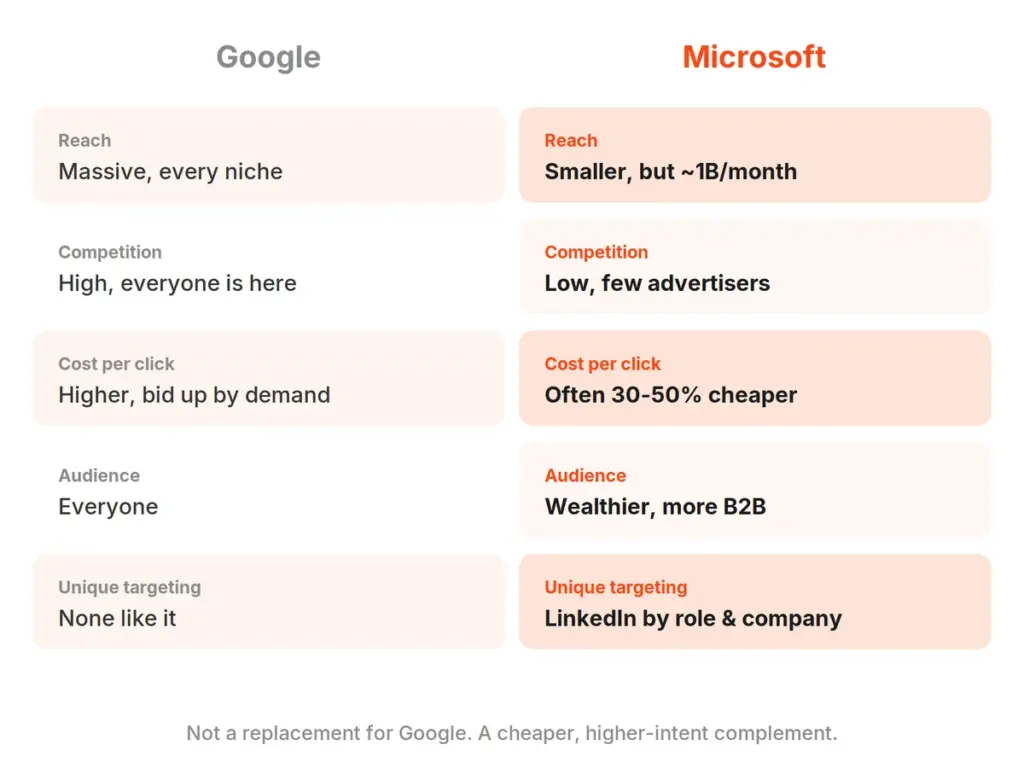
How the two channels stand side by side, in short:
- Google. Huge reach, demand in every niche, but high competition and a pricier click, because everyone goes there.
- Microsoft. Less reach, but lower competition and a cheaper click for the same intent, often a third to half cheaper for the same query, plus an audience and targeting Google doesn’t have.
It isn’t a replacement for Google, it’s a complement. Google takes the volume, Microsoft picks up the cheaper conversions Google never gave you.
Who actually searches on Microsoft
The audience is the whole point. It carries higher household income and a larger share of decision-makers. By Microsoft’s own data, close to half of its US users sit in the top quarter of household incomes, and a large slice hold purchasing authority at work. This isn’t a poorer Google, it’s a wealthier segment.
A few examples, to keep it off the abstract. A finance director hunting for reporting software from a work laptop. An office manager sourcing an equipment supplier. An IT lead comparing enterprise vendors between meetings. What they share is spending power and the authority to sign off, not a demographic box.
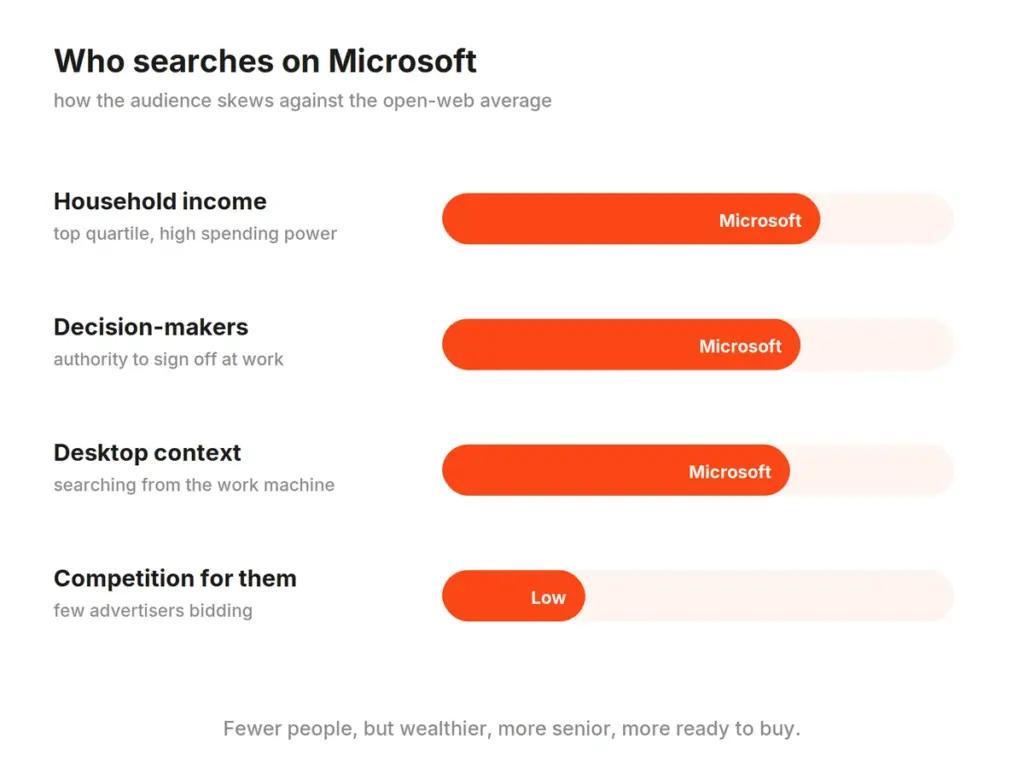
Device context sharpens it. Many of these people search from a work environment, where Edge and Windows are the default and the Office ecosystem sits alongside. Desktop during work hours means higher intent, longer sessions, bigger deals, and a person happy to fill in a form right there. Mobile hasn’t gone anywhere, Microsoft shows on phones too, and ignoring that trims part of your reach. The center of gravity just leans into desktop harder than on Google.
Hence the business tilt of the channel. And here Microsoft holds a lever no one else has. Because Microsoft owns LinkedIn, you can target by job function, company, and industry… Not a vague ‘men 35+,’ but, say, the finance function inside one specific industry.
LinkedIn Profile Targeting applies LinkedIn’s professional data, meaning company, industry, and job function, as bid adjustments on your campaigns. Because Microsoft owns LinkedIn, no other search channel offers this targeting, and it is what makes Microsoft strong for B2B.
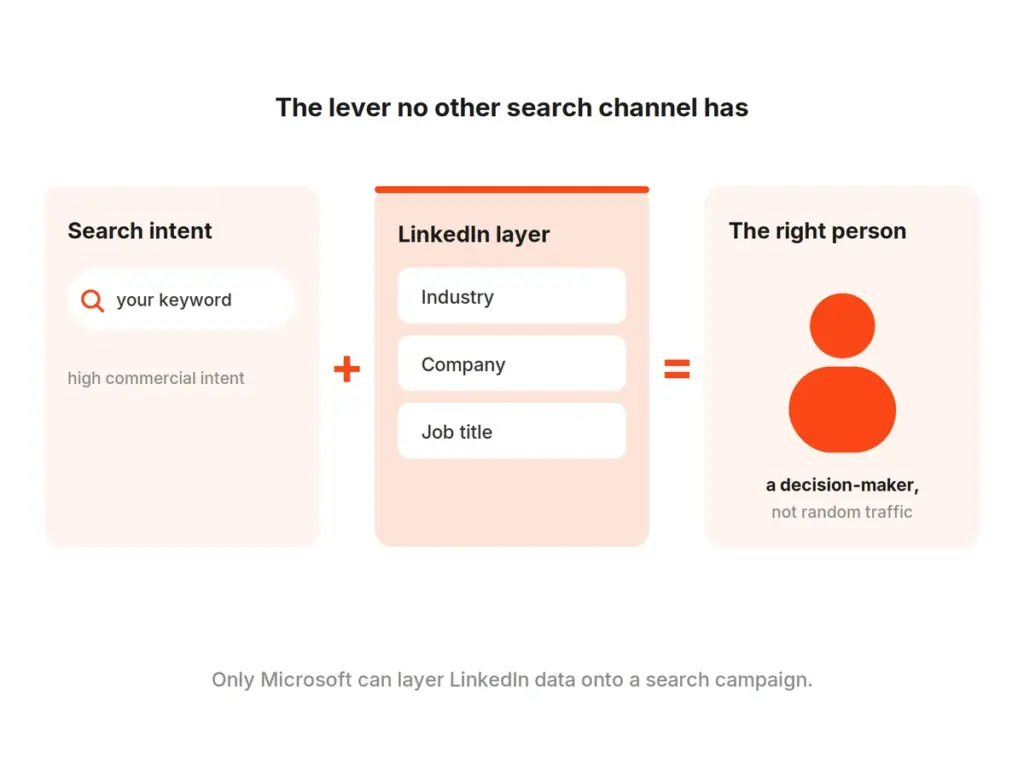
Correction: the third LinkedIn attribute is job function (e.g. Marketing, Finance, IT), not job title. Microsoft Ads does not expose individual job titles; that level of precision is only available on LinkedIn’s native ad platform.
Volume is the wrong ruler
The metric that buries Microsoft Ads in most audits is one thing. Low volume. We regularly watch the channel get written off on that number alone. But volume says nothing about money. The question isn’t impressions or even clicks, it’s cost per qualified result.
A cheaper click from a wealthier decision-maker can beat a pricier click from Google. What matters is the cost of a closed deal and how big that deal is.
Let me make it concrete. A company selling commercial water-treatment systems to offices and factories moved part of its budget into Microsoft Ads. The cost per lead came out higher than expected, and at first glance it looked like a loss. Look deeper, though, and the close rate on those leads ran several times better, and the deals were larger, because the people coming in were the ones making decisions, not random traffic. Per closed deal, Microsoft came out cheaper than Google, despite the higher CPL.
In practice, compare channels by the cost of a closed deal rather than CPC. And feed qualified conversions back into Microsoft, the confirmed sale and its value, so bids get counted from money instead of clicks. A channel that loses on volume, and even on cost per lead, can win where the money is counted.
Where the channel fits and where it doesn’t
To keep this from reading like an ad for the channel, here are the edges.
It fits B2B and SaaS, high-ticket lead gen, and expensive niches like finance, law, and insurance, where a Google click hurts and the Microsoft audience is wealthy and business-minded. Here the channel often returns the best cost per qualified result, and LinkedIn targeting finishes the job by reaching people by function, which the others can’t do.
It doesn’t fit young consumer and Gen-Z brands, or low-ticket impulse buys, whose audience lives on mobile and in social feeds. There the Microsoft volume is too thin to make it a priority. Those businesses sensibly test it only after they have wrung out Google and Meta.
This is a question of fit. Try Microsoft where your audience is business-minded and wealthy. And keep your first budget off it if you sell sneakers to teenagers.
Where it is all heading
The interesting part isn’t the current state, it’s the direction.
Microsoft has built Copilot and OpenAI’s models deep into Windows, Edge, Office, and Bing, so a large working audience now runs queries inside Microsoft’s products every day. Ads are gradually entering those AI answers, so the inventory now goes beyond classic blue links to a placement at the moment someone researches and decides through AI.
Copilot is Microsoft’s AI assistant, built into Windows, Edge, Office, and Bing. Your ads can show right inside its answers, so you catch intent before a person has made a choice.
The logic from here is straightforward. The more companies roll Copilot out across their workplaces, the more work-related search shifts from Google toward Microsoft. Early data from enterprise rollouts shows exactly that move in search share after deployment. For B2B this means your target audience increasingly researches solutions where a 100% Google strategy simply doesn’t show you.
It looks like everything is moving one way. The cheap-click window is unlikely to stay open forever. While most advertisers ignore the channel, competition is low and bids follow. But once budgets chase the audience into AI surfaces, that price advantage will start to fade. The logic points to building presence now, while the lower cost is still there.
Where to start in a new account
Testing Microsoft Ads doesn’t mean building a second large account. Here is the order of operations in a freshly created account, from the first step to what to watch a few weeks in.
Tracking first, campaigns second. Before launch, install the UET tag, which is Microsoft’s pixel, and define your conversions. Mark the qualified result as the conversion, not a click or a bare form fill. On a smaller channel a dirty signal hurts more than on Google, so getting your tracking clean and server-side can’t wait.
One campaign on your strongest intent. Don’t port the whole account at once. Take a narrow list of your Google-proven keywords with the best close rate and launch a single search campaign on them. The algorithm needs a concentrated signal, not one smeared across a hundred keywords.
Layer LinkedIn in from the start. For B2B this is the main reason to be here. Add targeting by industry, company, or job title on top of the search campaign, so you show to the people making decisions. Start in observation mode (bid only) to gather data without cutting your reach.
Strip out the noise early. For the first weeks, limit or separate delivery on the Microsoft Audience Network and search partners, so you can judge clean search intent, then expand. This saves your early budget from accidental clicks.
Bid from the result. Start with manual bids or optimization toward your conversion event, not toward clicks or cheap leads. Turn on automated strategies once you have enough conversions for them to learn from.
A trial budget. Aim for a small slice of what you already spend on Google, but enough to gather conversions over a few weeks. The goal is a first real read on cost per result.
After that, watch the close rate and deal size, not CPC and not click counts. To see why those leads convert or stall on the page, Microsoft Clarity shows the behavior behind the numbers. In a few weeks you will have your answer in money. Does the channel work in your niche or not.
Microsoft Ads FAQ
Are Microsoft Ads clicks really cheaper than Google?
Mostly yes. For the same query the click is often a third to half cheaper, because fewer advertisers compete for it. But a cheaper click isn’t the goal. The channel’s value is that the cheaper click also comes from a wealthier, business audience, so what to count is cost per qualified result, not CPC.
Is Microsoft Ads only for B2B?
No, but B2B and high-ticket are where it is strongest, thanks to the wealthy working audience and the exclusive LinkedIn targeting by function and company. It also works for expensive consumer niches like finance or insurance. It struggles where the audience is young, mobile, and impulsive.
How much budget do you need to test the channel?
Enough of a slice of your current Google spend to gather conversions and judge close rate and deal size, not clicks. Volume misses the point of the test. What you want is the cost per qualified result in your niche, and a few weeks will show it.
What is LinkedIn targeting and why does it matter?
Because Microsoft owns LinkedIn, meaning company, industry, and job function. No other search channel has this, which is why Microsoft is especially valuable for B2B, when you need to reach specific decision-makers.
Is importing your Google campaigns enough?
Import is the fastest way to start, but it’s where most people lose the channel’s edge. The audience, competition, and prices in Microsoft are different, so a campaign copied one-to-one runs below its potential. Why import doesn’t equal optimize, we’ll cover separately.
What to do with this
Microsoft Ads loses to Google on volume, but it is a different audience, wealthier and business-minded, with fewer advertisers competing for it, and the cheaper click reflects that. Writing the channel off on volume alone hands that audience to the few who are already there.
The fastest way in is importing your Google campaigns in a few clicks. But that is exactly where most people make the mistake that quietly drains the channel’s whole advantage, copy-paste without rework. Why import doesn’t equal optimize, and how to set Microsoft up properly, we’ll cover in the next piece.
Launching a campaign isn’t hard. The hard part hides in the details that decide whether the channel turns a profit: which event counts as a conversion, how to layer LinkedIn on top, how to keep the signal clean, how to measure close rate instead of CPC. On exactly those details, most self-run accounts quietly lose the channel’s edge. Advantrise starts by assessing whether your demand is on Microsoft search and at what cost per result, while the cheap-click window is still open and narrowing with every new advertiser that arrives.
Subscribe to our newsletter