
content
Your account can be built flawlessly and still leak budget.
No obvious mistake. Bids look right, audiences are dialed in, creatives are running. Yet month over month the results quietly slide, and you refresh campaigns, swap interests, recheck the pixel, and the needle never comes back.
The account probably isn’t broken. The rules underneath it changed, and your playbook is still from 2023.
Over the last 18 months Meta rebuilt how it decides who sees an ad at all. It used to be the audience you set. Now it is your creative, and the system decides who that creative fits. The change runs deeper than settings. It moved where your levers sit.
At Advantrise we run Facebook and Instagram ad accounts every day, and after this shift about half the usual advice simply stopped working. Below is what a working approach to Meta looks like in 2026: the structure to build, why creative became your targeting, which angles land, and what you still genuinely control.
What changed under the hood
Short version: Meta took the wheel from you and handed it to the algorithm, leaving you the job of supplying clean fuel.
The engine that now decides whose ad a given person sees is called Andromeda. It does not read your interests and lookalikes the way it used to. It reads the creative itself (the format, the hook, the theme, the tone) and predicts who it suits from behavioral signals.
Picture a casting director who scans millions of options in a fraction of a second and decides who even gets an audition. Andromeda is that casting call for ads. It picks which ads will show to a given person before the bidding auction starts. Miss the cut, and your bid no longer matters.
Andromeda is Meta’s new engine for deciding who sees an ad. It appeared in 2024 and by late 2025 had replaced the old model, where you set the audience yourself through interests and lookalikes, handing the first cut to your creative.
Alongside this, in February 2026 Meta shipped an API update that formalized what had been rolling out quietly all year. Detailed targeting is now treated as a suggestion, not a hard constraint. Your interests and demographics tell the system where to start looking, but it will move past them the moment it decides that is more efficient. And Advantage+ became the default for new Sales, Leads, and App campaigns.
Advantage+ is Meta’s automation (audience, placements, creative) that the system now expects to see switched on. It runs on top of Andromeda, so manual narrow settings tend to get in its way more than they help.
Why this happened now. Advantage+ and generative AI tools made the number of ads explode, with millions of advertisers uploading tens of millions of fresh creatives a month. The old audience-targeting infrastructure could not carry that volume. Andromeda is the answer to a scale problem, not just a new feature.
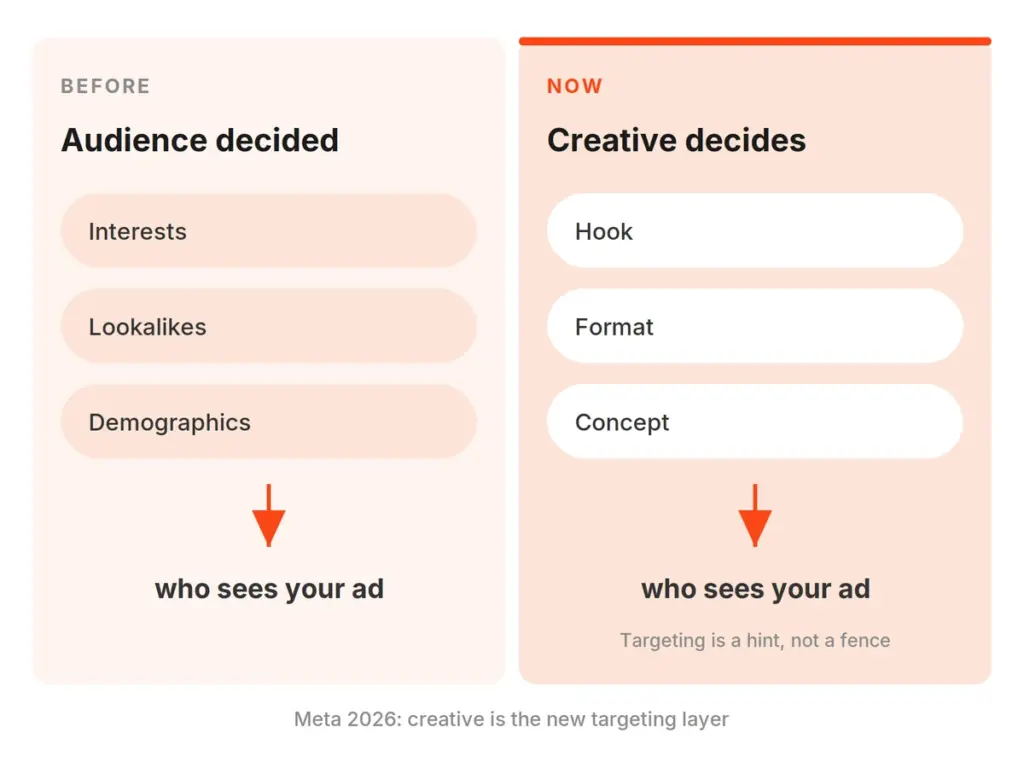
One practical takeaway. If creative now decides who sees the ad, all your effort has to move off audience setup and onto signal quality and creative variety. The rest of this article is how to do that.
Campaign structure: leaner, but fuller
The seasoned media buyer’s first instinct is wrong in 2026. The instinct says split: a campaign for cold, one for warm, separate ad sets for interests, for lookalikes, for retargeting. That is how we helped Meta find the right people for years.
Now it backfires. Every extra ad set chops your budget and signal into smaller pieces, and to learn steadily the algorithm needs concentration, not scatter. Fragmentation drags out the learning phase and makes delivery unstable.
So the direction is:
- Fewer campaigns and fewer ad sets.
- Broad targeting, or minimal segmentation.
- Budget at the campaign level, not smeared across a dozen ad sets.
- A separate ad set only when there is a real difference: a genuinely different audience, a different objective, a different geo or operational constraint. Different countries or different business units are reasons to split. “Women 25-34” against “women 35-44” is not.
When we rebuild an account around this logic, the working shape comes out simple. One or two consolidated campaigns hunting for new buyers or leads, plus a separate testing campaign where new concepts get proven before they enter the main one. Retargeting either folds into the same ecosystem or gets simplified hard, since Andromeda already has a decent read on who needs a second touch.
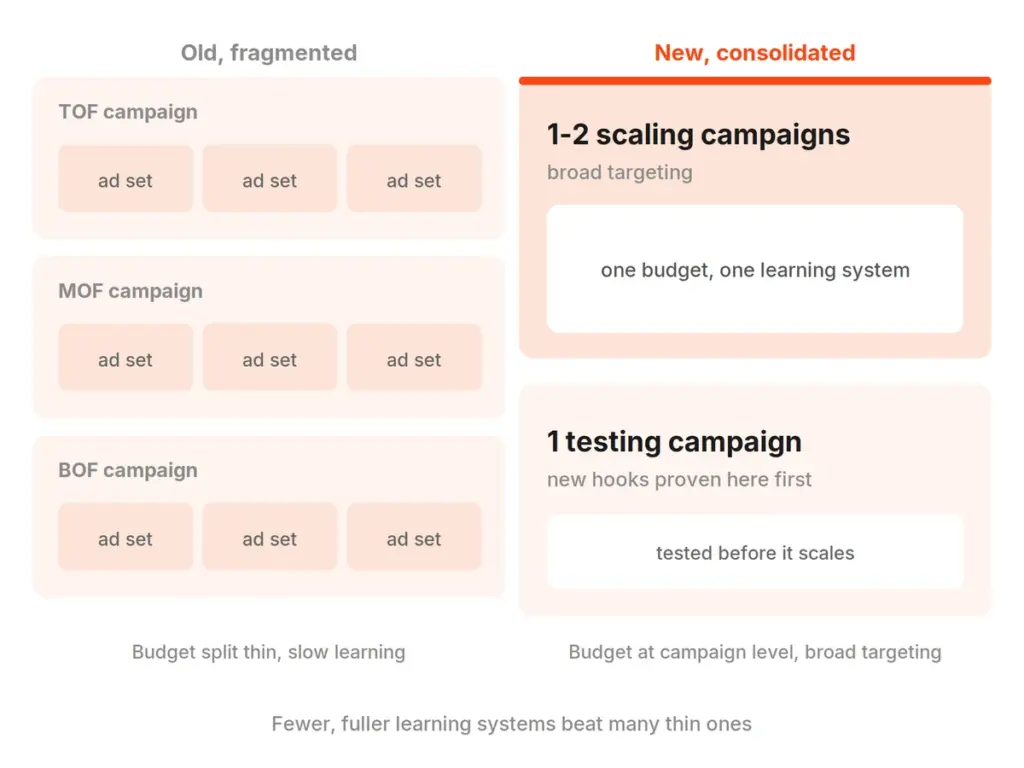
The irony is that account structure gets simpler exactly when more is being asked of you. The work just moved from the audience tab into the creative.
How much to put in at the start, enough to gather data, is its own conversation with its own logic, and we laid it out in our piece on Meta budgets. What matters here is different: whatever budget you take, splitting it across a dozen narrow ad sets in 2026 means teaching the algorithm on half-signals.
Creative became your targeting, and here are the main angles
It used to be that the audience decided who saw the ad, and creative was only what that audience saw. Now it is the reverse. Creative is your targeting. The hook and the message are what qualify who the system shows the ad to.
Andromeda is not hunting for one universal winner. It assembles a short list of strong ads that resonate differently with different people. A “winning” creative for one person can be completely irrelevant to another, even when both are into the same category. The system’s goal is plain: show the right person the right variation.
And here is the trap most people fall into. Small edits no longer count as different ads. You changed the headline, tweaked the background, dropped in a new overlay, shot the same hero at a slightly different angle, and Meta increasingly reads it as the same creative. The “find 7 differences” era is over. “Different” now means actually different:
- Different concepts and angles.
- Different narrative frames (problem-solution, pain point, transformation, testimonial, contrarian take).
- Different formats (UGC, static, video, carousel).
- Different personas and funnel stages.
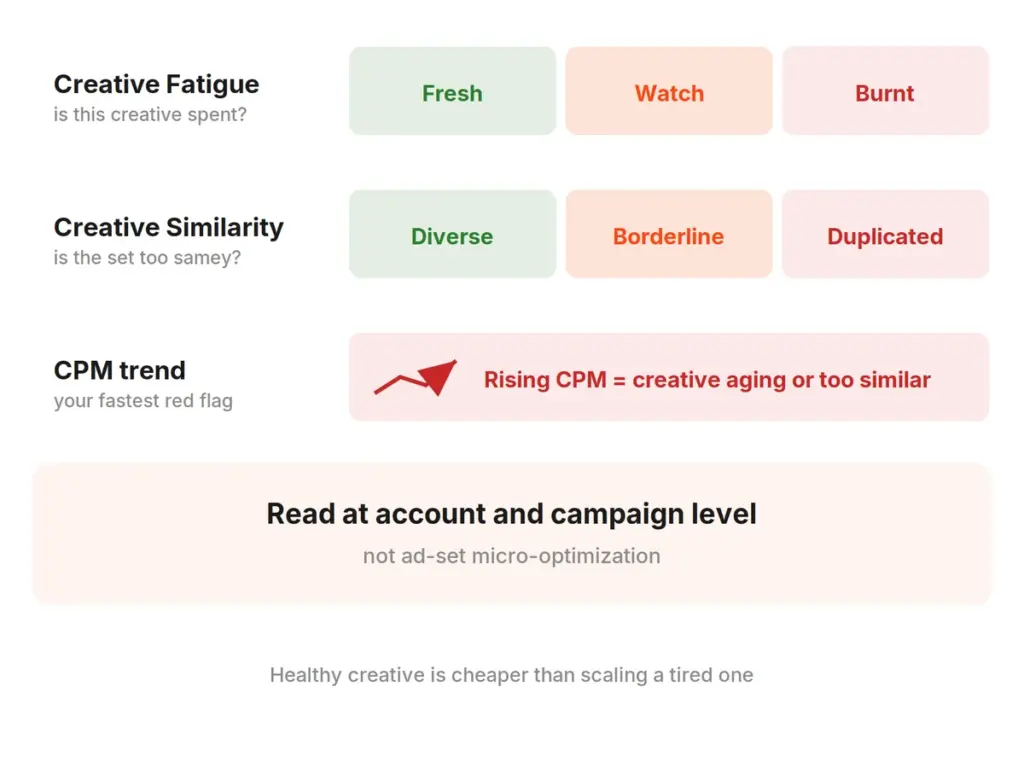
Creative Similarity is a signal for how alike your creatives are. When similarity is high, the algorithm treats the content as repetitive and the account gets higher CPMs. So a lack of variety costs you money, not only audience fatigue.
Why variety also scales. Different people buy for different reasons, even when they nominally share an interest. The more motivators you put in front of Andromeda, the more chances it has to find a match. One angle opens one pocket of the audience, another angle opens another.
I’ll make it concrete. Take a store selling premium organic dog food. One product, but the reasons to buy are wildly different, and each reason needs its own angle:
| Angle | Hook | Persona | Message | Key shots |
|---|---|---|---|---|
| Problem-solution | A picky dog turns away from the bowl again | Owners of fussy eaters | The food even the fussiest dogs finish | Dog sniffs, then eats with appetite |
| Health | Constant scratching, a dull coat | Dogs with sensitive digestion or allergies | Less scratching, more running | Before and after, glossy coat, an active dog |
| Convenience | Half past nine, the food just ran out | Busy owners, subscription | The food shows up on its own, you run nowhere | Box on the doorstep, the rhythm of a subscription |
| Ingredients and ethics | Buyers who read the label | Conscious shoppers who check the panel | A label you are not embarrassed to read aloud | Clean ingredients, transparent packaging |
| Social proof | Breeders switched the whole pack | New puppy owners | Why the professionals choose it | Real reviews, real dogs |
None of these rows wins with everyone. Together they hand the system five different doors, and it sorts out who gets which.
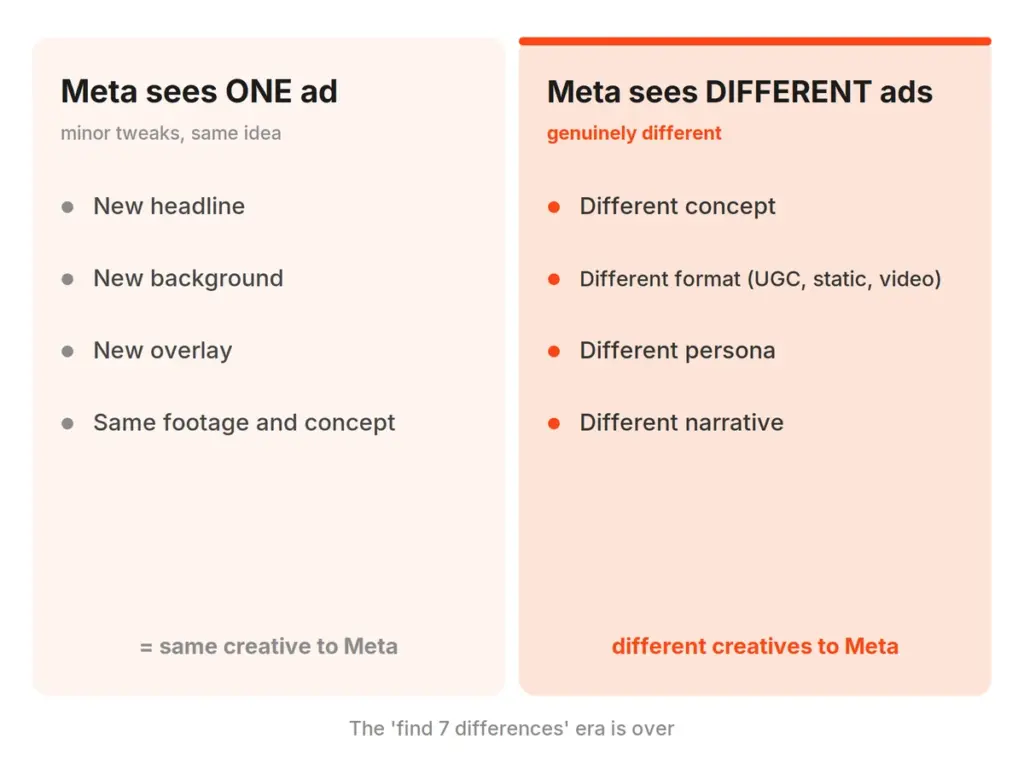
A working scaling set usually holds three or four fundamentally different hooks, different formats (UGC against polished against static), different emotional triggers, and different pacing. But there is a condition that is easy to skip. Before you roll a new hook into an established campaign, it has to be tested separately. That is why a testing campaign stays part of the structure rather than disappearing with the old fragmentation.
Signal quality: what it all rests on
Andromeda is exactly as smart as the signal you feed it. The best engine on dirty data just drives you confidently in the wrong direction.
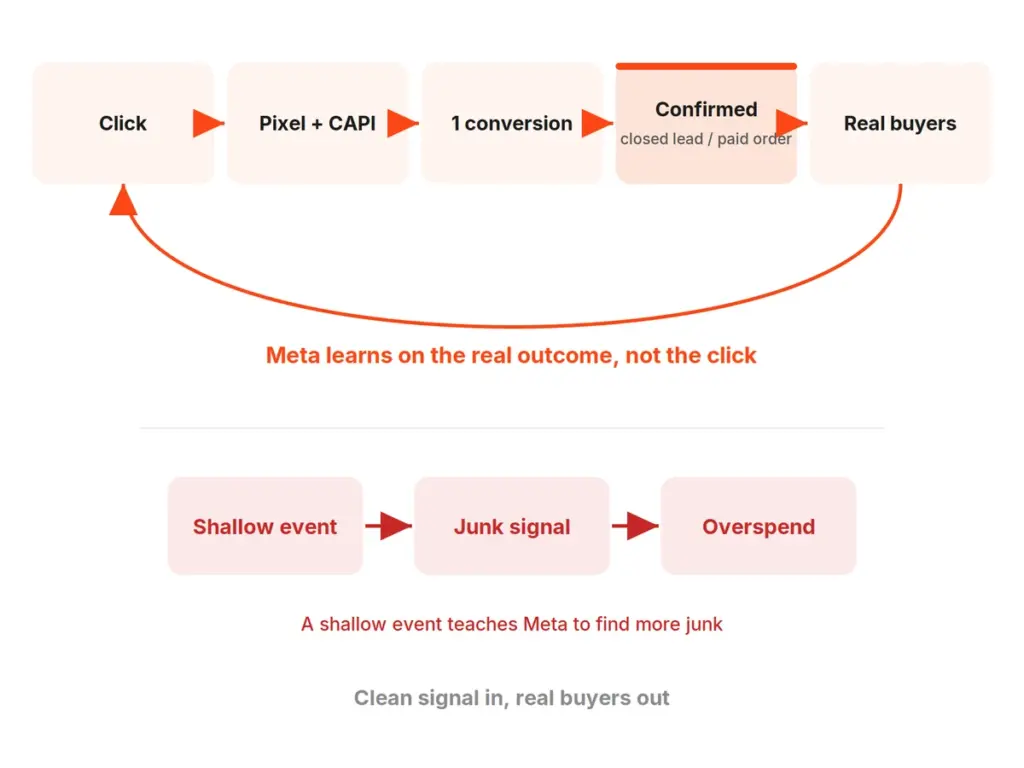
The basic hygiene here has not changed, but in 2026 it matters more than ever. The Pixel and the Conversion API run together, events match the real funnel on the site, and you optimize for one priority event rather than mixing five different ones in a single campaign.
The Conversion API (CAPI) is a server-side channel that sends events straight from you to Meta, on top of the browser pixel. It catches conversions the pixel loses to blockers, browser limits, and missing cookies, and gives the algorithm a fuller signal to learn from.
And here is the uncomfortable part most guides walk around. In 2026 a cheap result is often a warning, not a win. When you optimize for a shallow event (a form fill, an add to cart), the system diligently hunts for more of that same action, whether or not it ever became a sale. Lead gen gets hit the hardest.
A window-replacement company collects leads through a form. They switch on Advantage+ Leads, the form is as frictionless as possible, the leads pour in, the cost per lead halves. The dashboard looks like a party. And in the sales team, half the numbers never pick up, because they are accidental clicks.
Audience Network is Meta’s network of third-party apps and games where it also shows your ads. Some of that traffic is accidental or forced clicks (for example, tapping to close an ad inside a game), and that is where a noticeable share of fake leads settles.
The mechanics of the trap are simple, like training a dog. The algorithm is a hunting hound: whatever you mark as the quarry is what it brings back. Call a plain form fill a success, and it finds more people who will happily leave a form but never buy. Budget drains into chasing more of the same, the account fills with junk data, and the longer it runs the worse the system learns.
The way out is not to fear automation, it is to feed it the right result. Send back not the form fill itself but the confirmed, qualified result: a closed lead, a paid and unreturned order, real margin instead of revenue. Then the algorithm optimizes for money rather than an action counter.
Advantage+ and what you still control
The common fear goes like this: if targeting is advisory and Meta decides everything, what is left for the advertiser. Plenty is left. The levers just moved.
Automation does not replace strategy, it executes it. Your real levers in 2026:
- The offer. What you sell and on what terms. No algorithm invents that for you.
- The conversion event you optimize for. This is the strongest wheel of all, because it tells the system what to count as success.
- Exclusion lists. Existing customers, irrelevant segments, bad placements where they genuinely hurt.
- Creative direction. Which angles, which messages, how much variety goes into the system.
- Budget stability. Fewer panic interventions, more time for the algorithm to learn steadily.
The point is plain. You no longer draw a fence around who sees the ad. You feed the system the signals it builds delivery from, and you manage the quality of those signals. It is a different job than picking at interests, and it puts more control where it actually touches money.
How to measure now
Once the rules of who-sees-what change, the rules of what-you-watch change with them. Micro-optimizing individual ad sets lost its point, because there are fewer ad sets and decisions are made at a wider level.
Judge at the account and campaign level, do not yank every ad set. And get used to reading creative-level metrics, because creative now explains most of the difference in results. Meta is already rolling out signals that did not exist a year ago:
- Creative Fatigue shows that a specific creative is spent and it is time to swap it.
- Creative Similarity shows the set lacks variety and warns of higher CPMs.
Until you are used to the new fatigue metrics, keep CPM as your main red flag. If your cost per thousand impressions creeps up for no visible reason, your creative is most likely stale or too uniform.
Here I would look at cost soberly. CPMs on Meta are up noticeably year over year, by roughly a fifth, and that backdrop is not going anywhere. In practice it means one plain thing: if your creative did not get more effective, you pay more for the same impressions, and the margin melts.
A simple structure to start
Pulled into something you can build this week, it comes down to a handful of steps. Not the perfect account, a working base you scale from.
Step one, pick one priority conversion. For eCommerce that is usually a purchase, for leads a confirmed enquiry. Do not mix different events in one campaign.
Step two, set up clean signal. The Pixel and CAPI together, events matched to the funnel, and where you can, send back the confirmed result rather than the shallow action.
Step three, build the consolidated structure. One or two scaling campaigns hunting for new buyers or leads, broad targeting, budget at the campaign level. A separate ad set only where there is a real difference in audience, objective, or geo.
Step four, run a testing campaign. New hooks and concepts get proven here before they enter the main one, so you do not rattle what already works.
Step five, give the system varied creative. Three or four fundamentally different hooks, different formats, different personas. Not twenty variations of one layout.
Step six, switch on Advantage+ placements and do not poke the campaigns daily. Give the algorithm time to learn steadily, and read results at the account level rather than chasing a single ad set’s daily swings.
This is a system, not a one-time launch. You feed it clean signal and fresh creative, and in return it finds buyers more precisely than you would by hand.
FAQ – Meta ads in 2026
Do you need a lot of creative for Meta to work in 2026?
Yes, but what matters is variety, not volume. Andromeda personalizes delivery at the level of the individual, so it needs a set of genuinely different concepts, not twenty variations of one layout. A working benchmark is three or four fundamentally different hooks in different formats, refreshed as soon as you see signs of fatigue.
Should you turn off Advantage+ and go back to manual targeting?
In most cases, no. Advantage+ became the default precisely because it runs on the logic the platform moved to, and manual narrow structures now tend to lose to a fragmented signal. Turning off specific automations makes sense only selectively and deliberately, not as a way to get the old control back.
Can you still do narrow interest targeting?
You can, but it is advisory now. Your interests tell the system where to start looking, but it will move past them the moment it decides that is more efficient. So building your whole strategy on narrow audiences in 2026 is a fight against how the platform is designed to work.
Why do I get lots of cheap leads but few sales?
Most likely you are optimizing for a shallow event, and part of the traffic comes from low-quality sources, Audience Network among them. The algorithm sees a form fill as a success and hunts for more of the same. The fix is to send back the confirmed, qualified result, so the system learns on real sales rather than a form counter.
How do you tell a creative is fatigued?
The fastest signal is a rising CPM and a falling CTR with the same audience, along with climbing frequency. Meta is adding a separate Creative Fatigue metric, but until you are used to it, keep cost per thousand impressions as your main flag. If CPM creeps up for no reason, it is time to refresh the creative.
What to do with all this
It comes down to one shift in your head. Your job used to be organizing audiences. Now it is understanding people and handing the system clean fuel. Account structure got simpler, creative strategy got harder, and the winner is whoever takes that trade rather than fighting it.
You can build all of this yourself. A consolidated structure, the Pixel and CAPI, one priority event, varied creative, Advantage+ are within reach. But there are a lot of quiet failure points here. A segment chopped into half-signals. An event optimizing for junk leads. Creatives too alike for the system to see a difference, and a CPM surcharge for the privilege. Each one costs real budget, spent teaching the algorithm against an incomplete signal.
If you are not sure your account is feeding Meta the right signal today, Advantrise starts with a check of structure, data, and creative variety, because while the algorithm learns on half the picture, any scaling only speeds up the losses. And with CPMs rising year over year, the cost of waiting quietly grows every month.
Subscribe to our newsletter