
content
If your “partner pages” rank better than your core business pages, you may have a problem.
There is a moment every growing site eventually hits: the content that brings the most Google traffic is not the content you would proudly point to as “the heart of the brand”. For years, that gap was easy to justify with partnerships, special sections, and “helpful” third-party content. In 2026, Google is much less tolerant of that trade-off.
This article is not about partner content “dying”. It is about where the acceptable line moved, why the old argument “we review everything” no longer guarantees safety, and what we at Advantrise see as the practical way forward for teams that monetize responsibly without gambling with their entire domain.
Parasite SEO and site reputation abuse: what Google actually means
“Parasite SEO” is the industry nickname for a simple pattern: third-party content lives on a strong domain to rank faster and higher than it could on its own. Google frames the same idea as “site reputation abuse” and focuses on the core problem: using a site’s earned trust as a ranking shortcut for content that is not truly part of that site’s value proposition.
The tricky part is that the internet runs on partnerships. Guest posts, sponsored features, syndication, contributor columns, affiliate reviews, coupon pages, community content, even embedded tools can be legitimate. The difference is not whether the content is “external”. The difference is what the content is for, how it fits, and who truly controls it.
Google turned this into a dedicated policy.
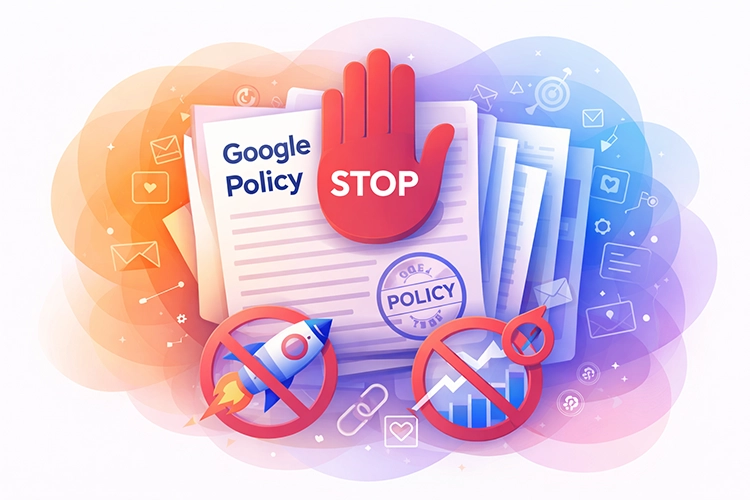
Where the line is today: what tends to be risky vs what tends to be fine
If you strip away jargon, the risk usually clusters around a few repeatable signals. It is rarely one thing. It is the combination.
-
A search-first motive: pages exist primarily because they can rank, not because your audience expects them from you.
-
A sharp topical mismatch: the section competes in a vertical your brand is not known for, yet it leverages your domain strength to win.
-
Operational autonomy: a partner effectively runs a “business inside your domain” with its own templates, publishing cadence, and monetization logic.
On the other side, the safer patterns are also consistent. The content is aligned with what your site already stands for, transparently labeled when it is advertising or sponsorship, and managed under real editorial and product standards. In other words, it looks and behaves like part of your site, not like a rented lane on your highway.
The timeline: why “we review it” stopped being a shield
Google introduced and formalized this policy in 2024, then clarified it in late 2024 in a way that mattered: “involvement” by the host site does not automatically make a setup acceptable. If the core purpose is to exploit a site’s reputation to rank content that would not compete on its own merit, the risk remains.
In 2025, the conversation became more concrete. Enforcement discussions moved from “theory” to “case patterns”: coupon directories, templated “best of” hubs, and large third-party sections that looked increasingly detached from the host site’s identity. The result is not a single rule you can memorize. It is a stronger expectation that the host site should not be used as a ranking accelerator for content that does not belong there.
The formats that most often trigger problems
This is where most teams get surprised: the risky formats are often the ones that scale beautifully.
Coupons and promo code directories are a common example. A single useful page is one thing. Thousands of near-identical pages built around “brand + coupon” queries is another, especially when the section is operated as a partner product.
Templated “best” and “reviews” hubs are another classic. They can be high quality, yet still feel like a shortcut if they expand into dozens of unrelated categories that the host site has no real reason to own.
And then there are rented subfolders or subdomains: sections that look like a separate platform living inside a trusted domain. The technical choice (folder vs subdomain) is less important than the business reality: if it is not truly your product and your audience does not expect it from you, Google may interpret it as reputation lending.
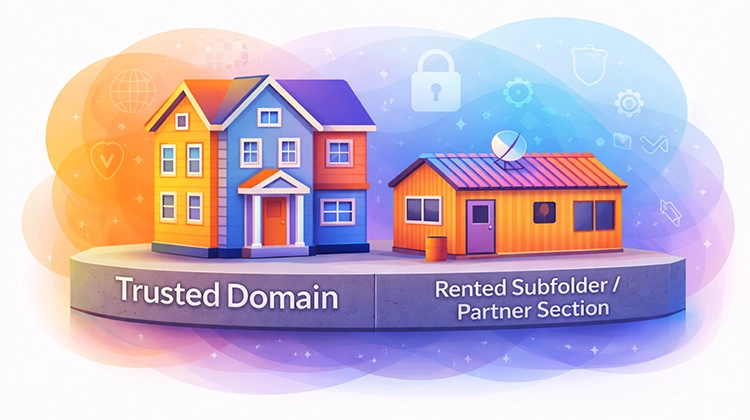
A practical checklist before you scale any partner section
You do not need a complex framework to pressure-test this. You need honest answers to questions that reveal intent and fit.
-
Would this section still be worth building if Google traffic dropped sharply?
-
Does the topic naturally match what your brand is known for, or is it a jump into someone else’s vertical?
-
Does the section feel integrated (navigation, tone, standards), or does it feel like a separate site inside your site?
-
Who controls decisions that matter: what gets published, how quality is enforced, how updates happen, what is removed?
-
If you removed your brand name from the header, would it still be obvious why this content belongs on your domain?
If these questions make the setup feel uncomfortable, that discomfort is usually a signal, not an overreaction.
Subdomains and “risk isolation”: not the magic switch people hope for
For a long time, moving a section to a subdomain was treated as a safety lever. In practice, it often became a cosmetic change: the same content, the same intent, the same reliance on the host site’s brand and trust, just a different URL format.
Today, that is not a reliable strategy. If a subdomain is effectively powered by the same reputation and exists primarily to compete in search, the move does not change the underlying story. Worse, repeated structural reshuffles (folder to subdomain, subdomain back to folder) can look like an attempt to outrun evaluation rather than fix the core issue.
Subdomains can still make sense when they reflect a genuine product boundary: a help center, a developer portal, a community platform, a separate SaaS offering. But treating a subdomain as a “shield” for search-focused partner content is a bet many teams no longer want to take.
How to run partnerships without turning them into a ranking liability
The safest mindset shift is simple: partnerships should strengthen your product, not replace it. Once you accept that, the decisions become clearer.
Keep topical discipline. The closer the content is to your real audience and your real expertise, the less it looks like borrowed authority. If your site is about ecommerce growth, partner content that helps ecommerce teams make better decisions fits naturally. If you suddenly host massive finance comparisons or broad coupon catalogs, the disconnect is hard to hide.
Be transparent where it is commercial. Sponsorship is not a crime. Disguised sponsorship is a trust problem. The long game in SEO is still trust: user trust, brand trust, and increasingly, trust signals that systems can infer from consistency.
Treat standards as non-negotiable. The moment a partner can publish at scale without your site-level quality controls, you are no longer curating content. You are hosting inventory.
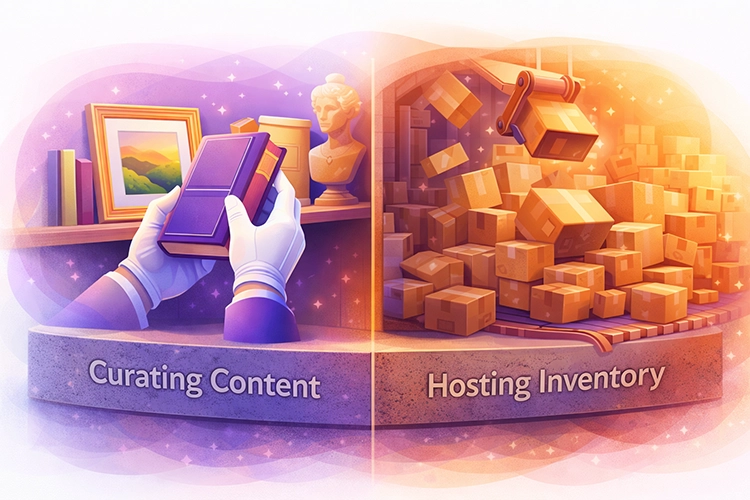
If you already have a “rented” section: realistic options that do not make things worse
This is the part where people rush into dramatic moves. Often the best approach is calmer and more surgical: reduce risk while preserving what is genuinely valuable.
-
Reduce scale and remove thin, templated pages that exist only to catch search queries.
-
Reframe the section so it serves your audience first and aligns with your site’s core topic, rather than competing in unrelated verticals.
-
Separate what is truly a different business. If the partner product is not meaningfully yours, moving it to its own domain may be the cleanest long-term solution, even if it loses the “domain boost”.
-
Avoid cosmetic migrations that keep the same intent. If the model stays the same, moving URLs rarely changes the outcome.
The goal is not to “hide” the section. The goal is to make the section make sense.
Where PPC fits into this story, practically
PPC is not a backup plan for bad SEO. In this context, it is a stability tool. If you are trimming or reworking a partner section, paid traffic can keep demand steady while organic visibility recalibrates.
More importantly, PPC data can help you replace shortcuts with substance. It tells you what people actually search for, what language they use, which pages convert, and which categories deserve deeper content investment. Building that kind of topic authority is the core of a sustainable SEO strategy – one that doesn’t depend on borrowed domain trust. When you build your own topic authority around real demand, you rely less on rented reputation and more on assets you control.
Conclusion: the short path got shorter, and the long path got clearer
Parasite SEO worked for so long because it was fast. It produced rankings without the slow work of building topical authority. That speed is exactly why it became a target: too often, it rewarded the structure of the domain more than the usefulness of the content.
In 2026, the safer bet is to build sections that match your brand’s real expertise, follow transparent monetization practices, and operate under consistent standards. Partnerships are still viable, but the bar is higher: alignment, clarity, and control matter more than ever.
If you want a second set of eyes on your partner content model, your site structure, and your risk exposure, we can help. Advantrise supports ecommerce brands with PPC and SEO as an ongoing growth system, not one-off experiments. The fastest way to start is through our Contact page, where we outline the first practical steps for collaboration.
Subscribe to our newsletter