content
Somewhere in your Instagram settings there’s a toggle that decides whether Google will show your Instagram posts. If you run a business account, it’s most likely already on, and you’ve never even heard of it.
What does it do? It puts your Instagram posts in Google results, Reels, carousels and captions included, next to ordinary websites, including your own. No campaigns, no budget. So the Instagram that stores are used to paying for already does part of the work for free, and the only question is who it works for. You, or the competitor who didn’t switch anything off either.
There are 2 free features like this on Instagram, and even people who have run Instagram advertising for a store for years rarely mention either of them. The first one gets you into Google. The second lets you test a reel on people who have never followed you, before you pay a single cent for an impression.
We’ll go through both, and at the end we’ll put together a short list of habits worth dropping.
Instagram in Google, and it’s not a bug
The toggle is called “Allow public photos and videos to appear in search engine results,” and it lives in your account privacy settings. For professional accounts it’s on by default. Go ahead and check while you finish this paragraph. We’ll wait.
A professional account on Instagram is a business or creator account. It’s the one that gives you insights, ads and visibility in search engines. There’s one more condition for indexing, which is age. The account owner has to be at least 18. Photos and videos from personal and private accounts aren’t covered by this setting.
Google had been finding individual Instagram pages without an invitation anyway. But for professional accounts, Instagram now opens the door itself, through a setting. For a store, that means a reel reviewing a product can show up in search results right next to the product page for that same product on your site.
Is that good or bad? It depends on where the person goes next.
Where a post from Google takes people
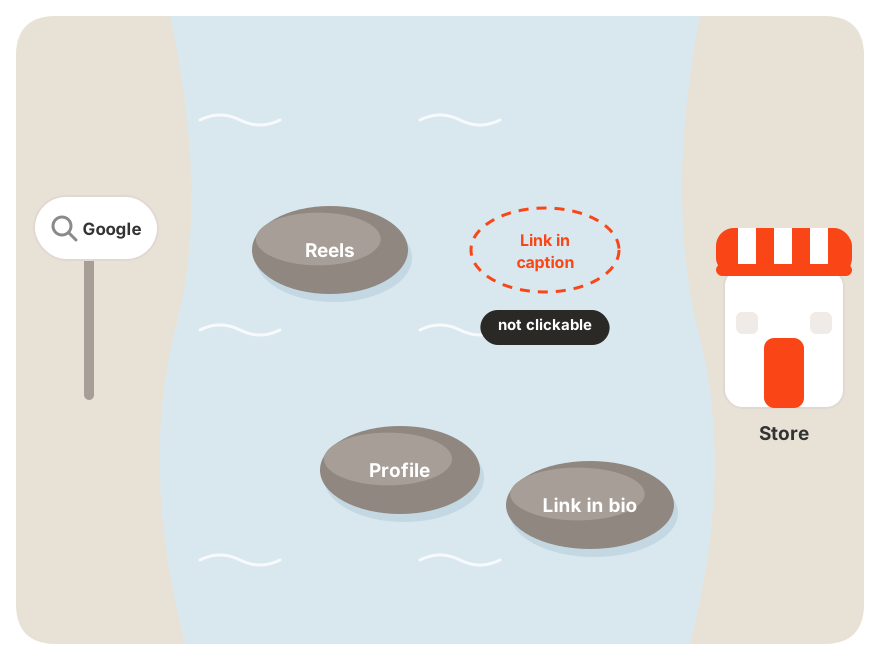
This detail is easy to miss. Someone coming from Google lands on instagram.com, not on your site. Links in post captions are still inactive for most accounts. And if the person isn’t logged in, Instagram in the browser greets them with a pop-up asking them to log in.
The result is an odd funnel. Search brings a shopper to your video, they like the video, and then they have to figure out on their own that they should go to your profile, find the link in your bio and only then reach the store. Some people simply go back to Google at this point. And maybe find a competitor there.
And an important caveat for analytics. This traffic won’t show up in your site’s Search Console, because it goes to someone else’s domain. So if a reel suddenly starts collecting views from search, Search Console won’t have a clue.
UTM tags on the link in your bio will at least let you see clicks from the profile to your site, since GA4 will then report them as a separate source.
Instagram posts can now rank in Google, but they send people to Instagram, not to your site. The caption and the profile have to get the shopper to the store on their own.
Your caption now works as a headline
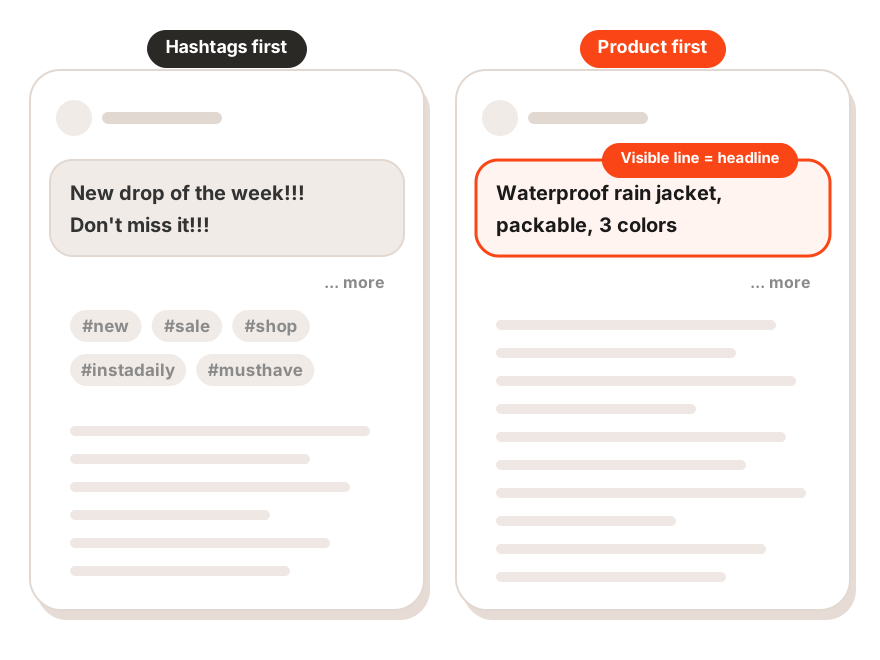
The first words of a caption act as something like a headline for search. That’s how marketers who analyzed the first indexing results read it. Instagram hasn’t published official guidance on this, so treat it as an observation, not a rule. The logic will be familiar to anyone who has ever paid for search engine optimization for their website. Whatever search sees first decides what the page is about.
Now picture a typical store caption with 3 emoji, “new arrivals this week!!!” and as many hashtags as Instagram will allow (which it has already cut to 5 per post). Fine for followers, next to nothing for Google. The model, the brand and the product’s main feature in the first line will do more for search.
There’s a flip side. For a brand, 2 spots in the results are usually better than 1. But if the reel appears above the product page, some of the clicks go to Instagram instead of your site. And then everything depends on how short the path from the post to the store is.
Don’t want to be in Google? You can turn the toggle off. But Instagram warns that search engines may need time to remove content they have already indexed.
Who will watch your reel to the end?
How many people who have never heard of your store would watch your next reel to the end? Instagram can answer that before a single follower sees it.
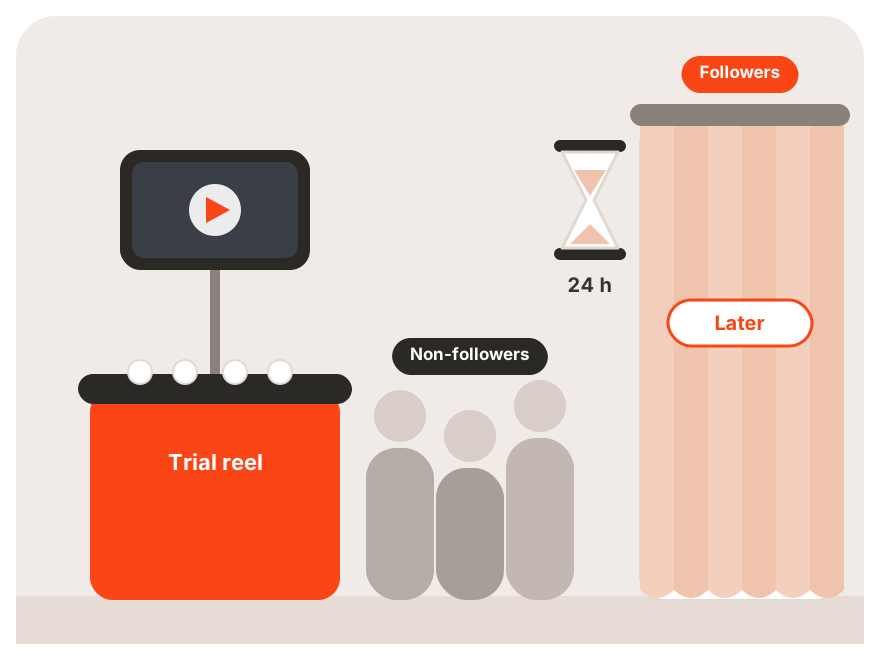
The feature is called trial reels. A trial reel is shown only to people who don’t follow you. It doesn’t appear on your profile grid or in your Reels tab, so your followers won’t know about the experiment. Unless someone sends it to them in a DM or they stumble on it through the same audio page.
Think of it as Schrödinger’s reel. It’s published and unpublished at the same time, until you look at the results.
A trial reel is a reel that Instagram shows only to non-followers. Insights appear after about a day, and you decide whether to share it with everyone.
Not everyone has access. You need a public account that’s eligible to appear in recommendations, and Instagram has changed the follower thresholds more than once. So the easiest way is to check for yourself. If you see a “Trial” toggle when you post a reel, you have the feature.
Strangers don’t hit like to be polite
Followers like your posts out of politeness. Regular customers, people you know, coworkers, that one client who likes absolutely everything. A cold audience doesn’t do that. It scrolls past if it’s not interested, which is why its reaction is a better read on whether a reel hooks someone who doesn’t know you.
About 24 hours later, a trial reel’s insights show views, likes, comments and shares. For a store, shares matter most, plus saves and retention if your insights show them. Shares and saves are a stronger signal of interest than a like given on the go.
If the reel performed well, you can share it with everyone manually or turn on automatic sharing. In that case Instagram looks at the views in the first 72 hours and, if the reel did well, shows it to your followers on its own.
1.7 seconds to make a first impression
Why does it matter at which second people leave? Back in 2016, Facebook calculated that on a smartphone, people spend an average of 1.7 seconds on a single piece of content in the feed. The popular story about the goldfish attention span was debunked long ago, but Facebook measured the 1.7 seconds itself.
There’s good news from the same series of studies, too. That same year, Facebook shared test results from the independent firm Fors Marsh Group. People recall content in the mobile feed after just a quarter of a second of exposure. So there is a chance, it’s just very short.
Both numbers are more than 10 years old, they describe the Facebook feed, not Reels, and the feed has hardly slowed down since.
But the principle holds. For Reels, Instagram shows your skip rate for the first 3 seconds and a retention chart, so you can check this against your own numbers. The product, the brand and a reason to keep watching belong in the first frames, not at second 7 after a pretty logo intro.
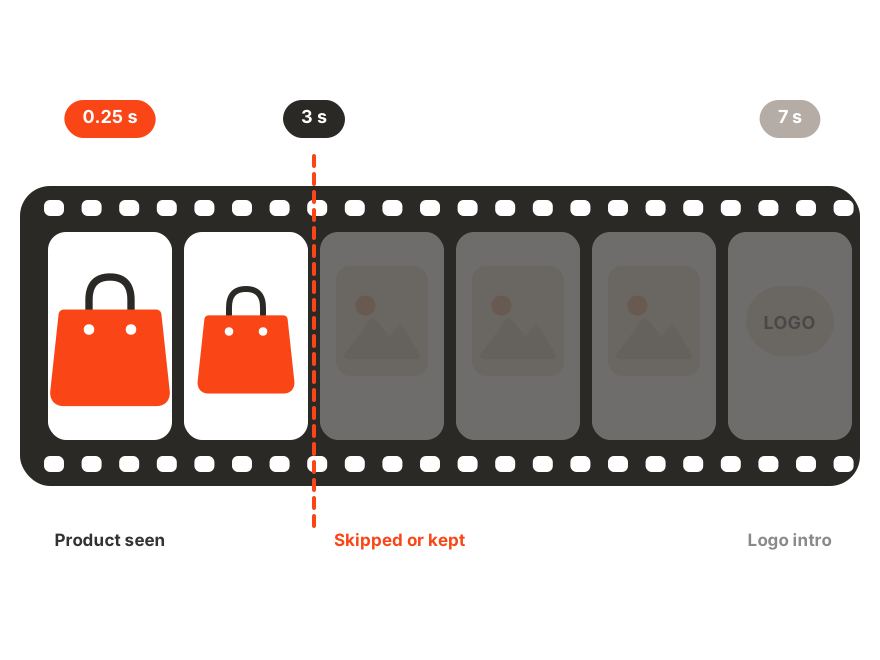
A trial reel weeds out weak ideas and hooks before you spend anything, but it doesn’t predict your cost per purchase. Watch shares and how many people didn’t skip the reel in the first 3 seconds.
From trial reel to ad
From here the logic is simple. Pay for reels that have already proven a cold audience will watch them. Share the winning trial reel with everyone first, then promote it as an existing post so you keep its likes and comments. Weak reels just stay in your trial reels without eating a cent of your budget.
This doesn’t replace creative testing in Ads Manager. A trial reel is seen by an audience chosen by the recommendation algorithm, not by your location and targeting, and it doesn’t measure purchases. But as a filter for “is this worth launching at all,” it works better than a meeting of 3 people who all happen to like the video.
What to stop doing
- Hitting “Boost” under whatever post is handy. Trial reel first, money second.
- Judging a reel by your followers’ likes. They already love you, and ads need the people who don’t yet.
- Starting captions with emoji and hashtags. Google reads the first line now too.
- Putting a logo and an intro in the first seconds. In those seconds people need to see the product, not your brand book.
- Forgetting about the path from search. Your profile and the link in your bio should lead somewhere people can buy.
Instagram posts in Google FAQ
Do Instagram posts show up in Google?
Yes, if the account is public, professional and owned by someone 18 or older. Since July 10, 2025, these accounts have a setting that allows indexing, and it’s on by default.
How do you stop Instagram posts from showing in Google?
In your privacy settings, turn off the toggle that allows public photos and videos to appear in search engine results. Search engines may need time to remove content they have already indexed.
What are trial reels on Instagram?
They’re reels that Instagram shows only to non-followers. After about a day you see the insights and decide whether to share the reel with your followers.
Why don’t I have trial reels?
The feature is available to public accounts that are eligible to appear in recommendations, and the follower thresholds have changed over time. Check your account status in settings and look for the “Trial” toggle when you post a reel.
Can you use a trial reel in ads?
Yes. The simplest way is to share it with everyone first and then promote it as an existing post, so its likes and comments stay. It doesn’t guarantee results, but it weeds out ideas that didn’t interest people even when the views were free.
While your competitor pays to find out
Both features are free, and plenty of stores ignore both. One brings people in from Google, the other shows which reels are worth paying for at all.
A competitor who still hits “Boost” at random pays from the ad budget even for ideas that could have been filtered out for free. If you want your tests to cost less and the reels you invest in to be proven first, talk to Advantrise. Let’s start before the most expensive ad season heats up the auctions even more.
Subscribe to our newsletter