
content
“Divide and conquer” has served politics for centuries and once worked rather well in Google Ads. Applied to Google Ads account structure, the old Latin maxim works in reverse. The finer you split, the less you control.
Back when bids were set by hand, every extra campaign gave you one more lever. Now an algorithm picks the bid for every auction, and it needs conversions, ideally gathered in one place. Spread across 30 campaigns, they turn into 30 samples, none of which proves anything.
The levers haven’t gone anywhere. Google has simply moved some of them inside the campaign. If your account still remembers manual bidding, Google Ads management should start by working out which levers already live inside the campaign and which still call for a campaign of their own.
Where 40 campaigns come from
Nobody sits down to design an account with 40 campaigns. They pile up on their own, like the bag of bags under the sink.
First came the SKAG craze. Then separate campaigns for mobile, because conversion rates differ there, and for every city, because clicks cost more in Sydney. Then a Black Friday sale nobody switched off. And a test campaign only one person knew about, who left the company ages ago.
SKAGs (single keyword ad groups) are ad groups with one keyword each. The approach was popular in the 2010s, when exact match still meant (almost) the exact query and every keyword got a hand-set bid.
Each of these decisions made sense once. Then exact match started catching close variants and even paraphrases, and Smart Bidding stopped paying attention to device bid adjustments. Only -100% still counts, and with Target CPA a device adjustment changes the target itself, not the bid. Half the reasons disappeared along with manual bidding. The campaigns, of course, stayed put.
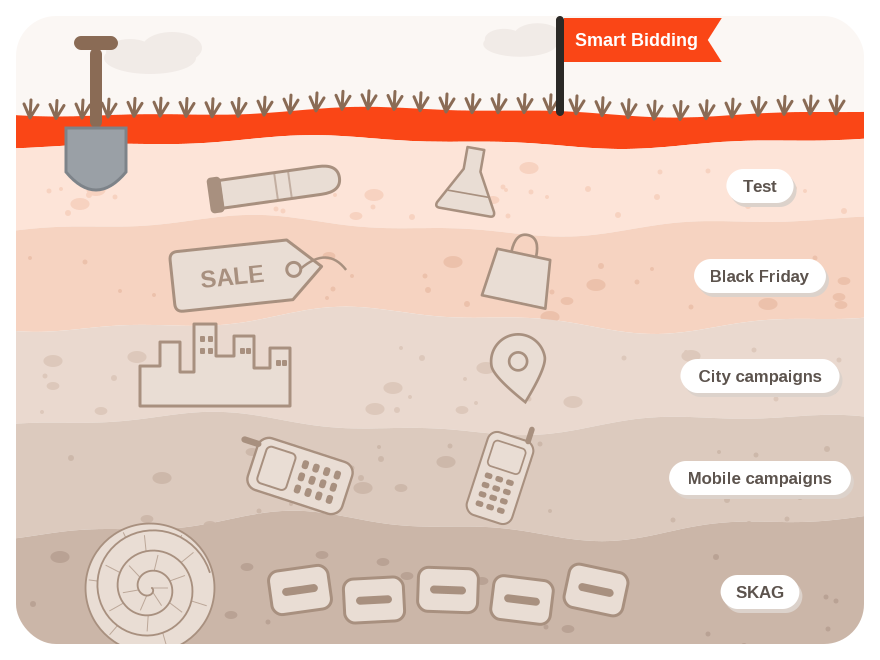
So the structure deserves one test. Which of these 40 still remembers why it’s here?
How much data the algorithm needs
“Target CPA needs 30 conversions in 30 days” still does the rounds in checklists, although Google’s current help pages contain no such requirement.
You can switch on Target CPA with no conversion history at all. The number 30 survives in the help pages as advice on how many conversions to judge results by, which is a slightly different story.
Target ROAS is stricter. Search and Shopping need at least 15 conversions in the past 30 days, and Google counts them at the conversion tracking level, so splitting campaigns doesn’t switch the strategy off here. In Demand Gen the threshold is counted per campaign, at 50 conversions in 35 days with 10 of them in the last week. Unless the account has 100 conversions across all Demand Gen campaigns, needless splitting can leave you without Target ROAS altogether.
What about Search? Google says Smart Bidding learns from data across all your campaigns, so a new campaign doesn’t start from zero. What goes hungry here is your reporting.
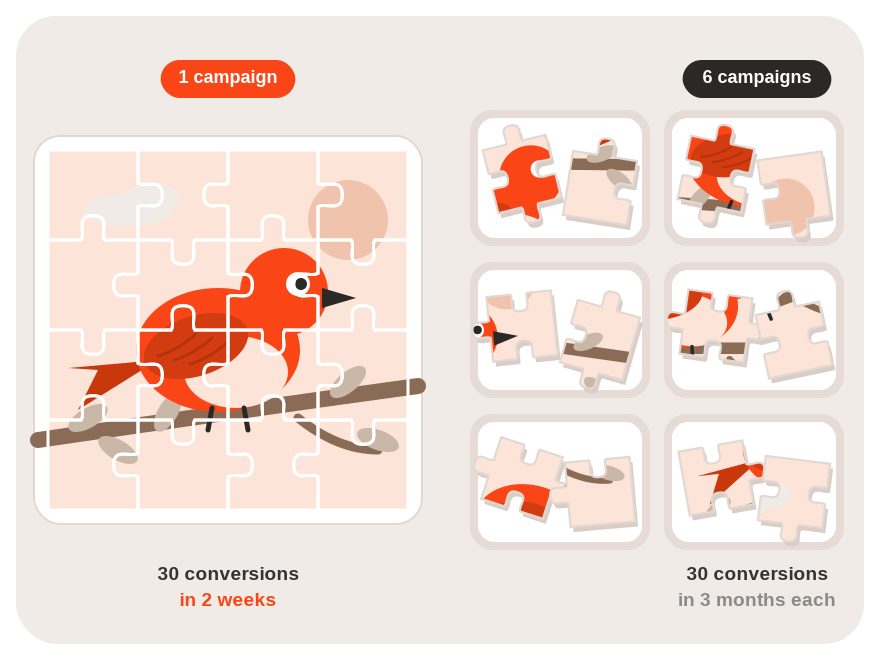
Take a hypothetical store selling birdwatching gear, with 60 online orders a month. Split them across 6 campaigns and each gets 10 on average. Each will take 3 months to reach the 30 conversions Google suggests for judging Target CPA, while a single combined campaign gets there in 2 weeks. For Target ROAS Google suggests waiting for 50, which makes it 5 months versus less than one.
In 5 months the prices will change, so will the season, and possibly the person who set those campaigns up.
A conversion cycle is the time from click to purchase. For a bag of birdseed it can be an hour. For $600 binoculars it can be 2 weeks of thinking and 3 YouTube reviews.
Google promises to clear the “Learning” status within 7 days at most. Stabilisation, by its own account, can take up to 1-2 conversion cycles, so for binoculars the first week will show little more than the early reaction to new bids.
Google advises against judging Performance Max earlier than 6 weeks after launch. The API documentation recommends a daily budget of at least 3 times your target CPA, so a campaign with a $40 target per order and a $30 daily budget falls short of that recommendation before it serves a single impression. It needs at least $120.
Demand Gen is the strictest of all. There Google AI learns at the campaign level, the advice reads “avoid fragmenting data”, and ad groups that collect fewer than 30 conversions in 30 days are candidates for merging.
Conversions scattered across campaigns rarely switch a strategy off, except in Demand Gen. But every campaign has to be judged on its own small sample, and conclusions take several times longer to arrive.
The one-difference rule
A separate campaign only earns its place where you’re ready to make a different decision, which means setting a different budget, a different target, or talking to customers in another language. Google puts it more drily. If keywords share a budget and a target, they belong in the same campaign.
Back to the birds.
Say binoculars give the store a 12% margin and birdseed 40%. Break-even ROAS for binoculars sits around 833% and for seed at 250%, so any shared target in between sells binoculars at a loss and holds back seed sales at the same time. If you pass margin into Google Ads as conversion value, one campaign can handle this. If you can’t, a second campaign with its own target is justified, and that arithmetic is where ecommerce PPC that turns a profit begins.
| What’s different | Separate campaign? | Why |
|---|---|---|
| Margin not passed as conversion value | Yes | Different bidding target |
| Budget you can’t hand to other campaigns | Yes | Different spend limit |
| Country or language | Yes | Different ads, prices, often currency |
| Brand and non-brand | Yes | Different cost per click and target |
| Categories with the same margin | No | Ad groups, product groups or listing groups will do |
| Keyword match type | No | Google says Smart Bidding doesn’t need it |
| Devices | No | Smart Bidding accounts for device in every auction |
| Cities within one country | Mostly no | Conversion value rules will do, if you use value-based bidding |
Did you notice that none of the “Yes” rows has anything to do with how your site is built? Leave the category tree in the site menu. Account structure should follow your decisions about money.
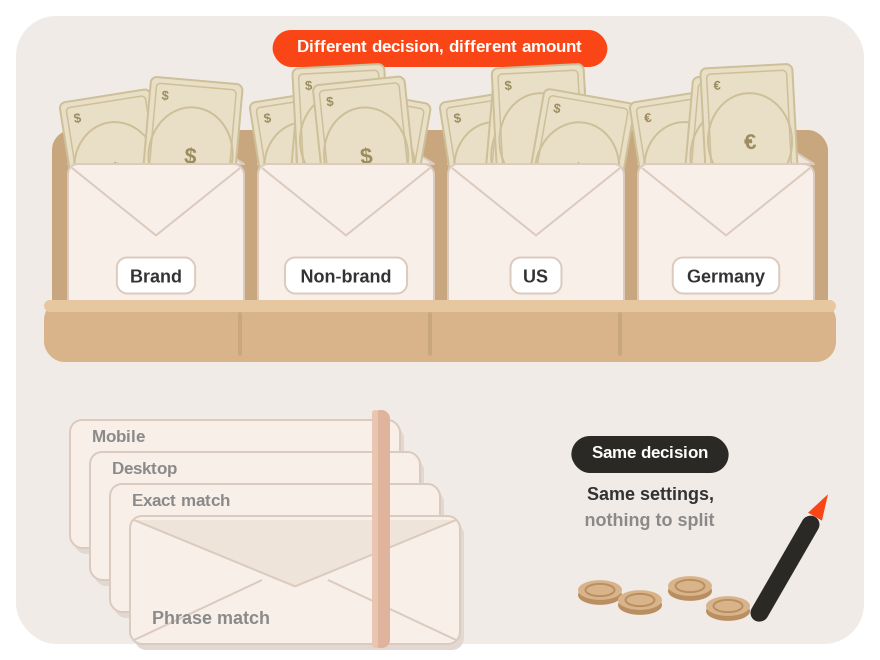
Splitting has moved inside the campaign
Google behaves here like a grandmother who tells you to finish your soup while putting 3 desserts on the table. One hand urges you to consolidate campaigns. The other has spent years adding tools that let you tell things apart inside a single campaign anyway.
Some of the old reasons for a separate campaign are now covered by settings.
- Conversion value rules. You can tell the algorithm that a purchase from a particular region, device or audience is worth more or less to you. They work with Target ROAS and Maximize conversion value, and this used to mean a separate campaign with its own bid.
- Seasonality adjustments. They warn Smart Bidding that the conversion rate will jump during a sale. They’re designed for events of 1-7 days, and Google itself says adjustments longer than 14 days may not work as well.
- New customer acquisition goal. Lets you bid higher for new customers or bid for new customers only.
- Channel prioritization. Google is rolling out a setting that gives channels high or low priority and caps the share of daily budget for low-priority ones, such as Search partners. Google keeps to the cap “on a best-effort basis”, meaning it will try.
Each of these switches only asks the algorithm nicely. A separate campaign with its own budget gives you firmer control, though even that isn’t a hard ceiling, because Google can spend up to 2 times the daily budget in a day and evens things out over the month.
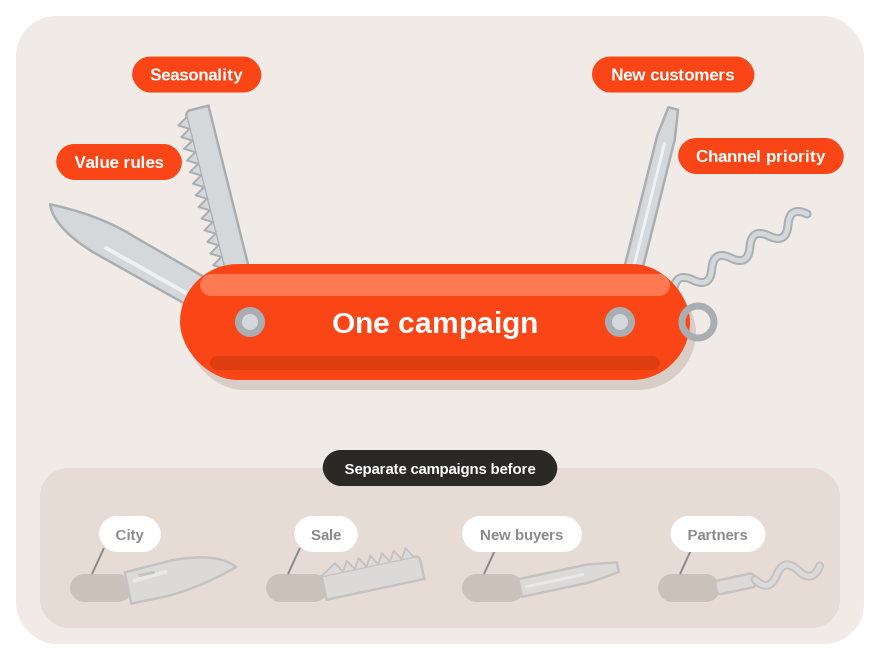
If the difference between products or audiences can be described with conversion value, a setting will do. If the money has to be split, you need a separate campaign.
Splitting to see
What share of your ad sales comes from people who were searching for your brand anyway?
If brand and non-brand run in one campaign, you don’t know. The algorithm does, and it’s delighted, because brand searches are cheap and convert beautifully. The campaign’s ROAS looks like an investor slide, even though some of those people would have come through organic search for free. It’s a bit like counting your shop’s visitors together with the staff.
That’s why brand gets its own campaign. First to see what it really brings in, then to give it its own target, because once the numbers are visible, the decision changes. Performance Max has brand exclusions, which apply to Search, Shopping and YouTube search inventory.
Sometimes you want to split purely for reporting, for example by categories with the same margin. Then the campaigns can share one portfolio bid strategy, and they keep a single shared target.
A portfolio bid strategy is one strategy applied to several campaigns, optimising bids across all of them together. Budgets can stay separate, although Google recommends pairing a portfolio strategy with a shared budget. Portfolio strategies aren’t available for Performance Max.
Rebuilding without breaking learning
The ship of Theseus can be replaced one plank at a time, and philosophers still argue about whether it’s the same ship. In a Google Ads account the question is simpler. Every plank you add to a bid strategy or remove from it restarts learning.
Google lists 3 things that trigger learning.
- A new or reactivated bid strategy.
- Campaigns, ad groups or keywords added to or removed from the strategy.
- A significant change to conversion goals.
Budget changes are where it gets interesting. The main help page says they never trigger the “Learning” status, while the Performance Max page advises against frequent budget changes because they can reset the learning phase. When Google can’t agree with itself, it’s safer to change budgets gradually.
Structure is a different matter, and it’s better rebuilt in one go. Merge the campaigns, update the conversion goals, then leave the account alone for at least 1-2 conversion cycles. Pausing old campaigns is handier than removing them, because they’re easier to bring back, although re-enabling one restarts learning.
A new Performance Max campaign gets the same 6 weeks, and after significant changes to an existing one Google suggests 1-2 weeks or at least one full conversion cycle. If the rebuild lands in October, the algorithm may meet the November sales only half ready.
One big structural change triggers learning once. Small tweaks every week trigger it every week.
A checklist for your account
Marie Kondo suggested asking whether each item sparks joy. For campaigns, the questions are more practical.
- Does this campaign have its own budget, target, language or country? If not, it’s a candidate for merging.
- How many conversions does it collect in 30 days? For Demand Gen ad groups Google suggests merging anything below 30, and in our view the same bar is a useful guide for Search too.
- Are test and sale campaigns from past seasons still spending $5 a day without anyone noticing?
- Are campaigns split by device or match type?
- Where do your Dynamic Search Ads live? From February 2027 Google will start upgrading DSA to AI Max automatically, and you can upgrade yourself now, so it pays to plan their new home in advance.
- Can you see brand separately from non-brand in your reports?
Google Ads account structure FAQ
How many campaigns should a Google Ads account have?
As many as you have different decisions about budget, target, country or language. A small store often gets by with a handful, and the number of categories on the site has almost nothing to do with it.
How many conversions does Target CPA need?
Google’s current help pages set no minimum, and you can switch the strategy on with no conversion history. Google recommends judging results on 30 conversions or more.
How many conversions does Target ROAS need?
For Search and Shopping, at least 15 conversions in 30 days at the conversion tracking level. For Demand Gen, 50 conversions in 35 days in the campaign, 10 of them in the last 7, or 100 across all Demand Gen campaigns in the account. Performance Max has no separate threshold.
Should you split campaigns by device?
Mostly no. Smart Bidding accounts for device in every auction, and most strategies ignore device bid adjustments except -100%. With Target CPA such an adjustment changes the target for that device, so you don’t need a separate campaign there either.
How long does Smart Bidding learning last?
The “Learning” status lasts no more than 7 days, while stabilisation can take up to 1-2 conversion cycles. Learning is triggered by a new strategy, by campaigns or keywords added to or removed from the strategy, and by a significant change to conversion goals.
While your competitor feeds 40 campaigns
Every extra campaign takes a little budget from its neighbours and a little attention from you. 40 helpings of “a little” already show up in your reports, just under different labels.
If you want a structure where every campaign has a reason to exist, talk to Advantrise. Better to finish the rebuild before the next sales season. The algorithm will be learning either way, and the only question is whose money it learns on.
Subscribe to our newsletter