content
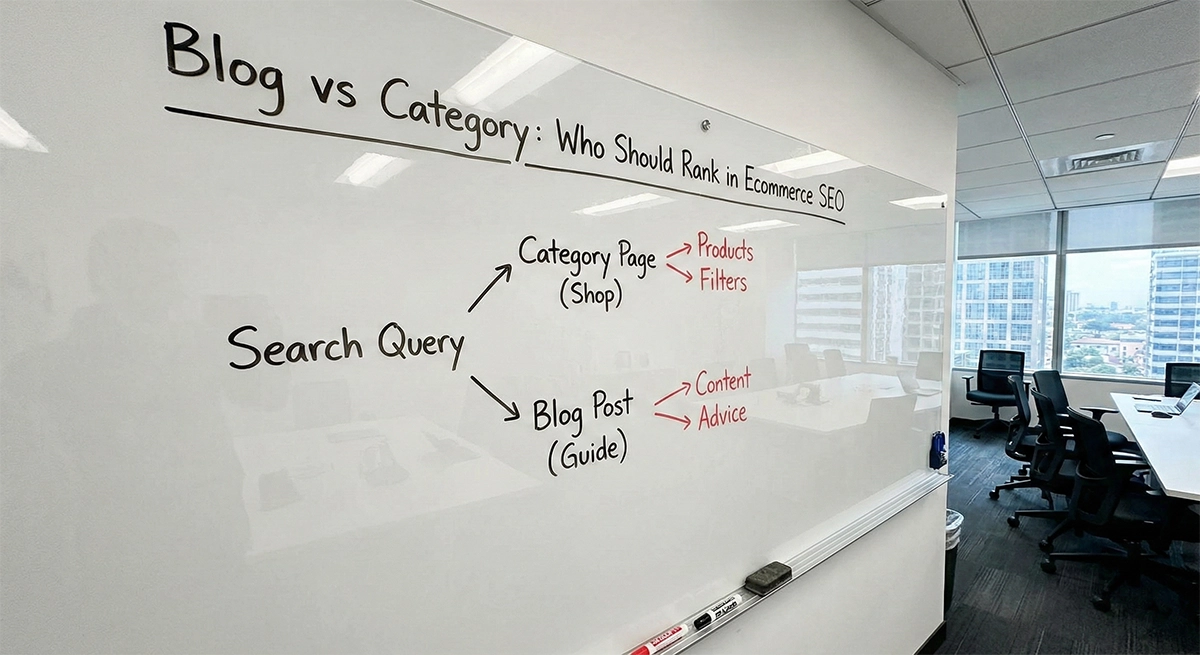
In ecommerce SEO, there is a strange kind of success that feels good on a dashboard and terrible on a bank statement: your blog post starts ranking for a high-volume product term, while the category page you actually want shoppers to use fades into the background. Traffic looks healthy, the content team gets a well-deserved morale boost, and conversions quietly decide to take a long lunch.
At Advantrise, we run into this pattern when stores invest in helpful guides (which they should) but never assign clear roles to pages. If you recently built momentum with a structured SEO push, the same idea applies here: structure is what turns visibility into predictable revenue. For a quick example of that mindset, our 7-day Q1 SEO sprint breaks down how small changes in structure and priorities compound fast.
This article is about making one decision consistently: for a given topic, which page type should be the main ranking candidate: a category page or a blog post? Once you can answer that question with confidence, most SEO chaos turns into a manageable system.
Why this conflict happens in the first place
Search engines are not trying to reward more content. They are trying to reward the best match for a user’s intent, right now. That intent is often visible in the query itself. A person typing a broad product phrase typically wants a catalog experience. A person typing a question wants an explanation. And a person typing best wants a curated opinion. The trouble starts when your site answers the same intent with two different URLs.
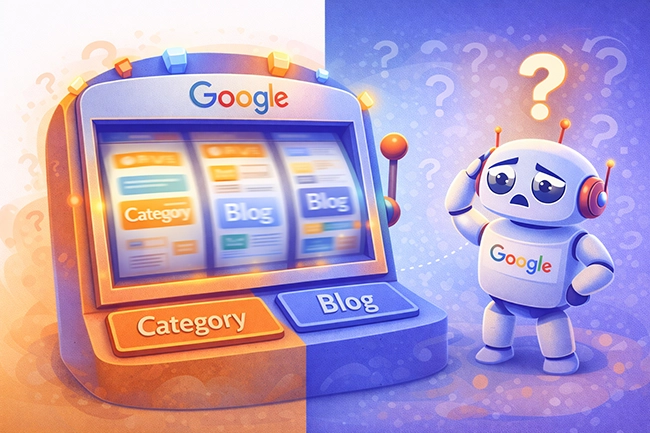
Years ago, ranking multiple pages for the same keyword could look like dominance. Today it often looks like indecision. If two pages send overlapping signals, Google may test both, rotate them, or pick the one that performs better on engagement even if it performs worse for revenue. Your job is to remove the ambiguity so the algorithm does not have to guess. Getting this structure right is one of the most impactful things you can do in eCommerce SEO – it directly affects which pages rank and which pages convert.
Read the SERP before you edit your site
Before you touch titles, internal links, or page copy, do the simplest diagnostic step: search your target query and look at what is ranking. The search results page is Google’s hint about what users typically want.
If the top results are dominated by product listing pages from retailers, the intent is transactional. If the top results are dominated by editorial lists, guides, and review sites, the intent is commercial investigation. And if the results are mixed, it usually means the query is ambiguous and Google is hedging.
A mixed SERP is where many ecommerce teams get overconfident. They see one or two category pages and assume their category should rank too. But mixed results often mean Google is still deciding, which is a polite way of saying your site can accidentally talk itself out of a good position.
A quick modifier cheat sheet helps you scale intent decisions:
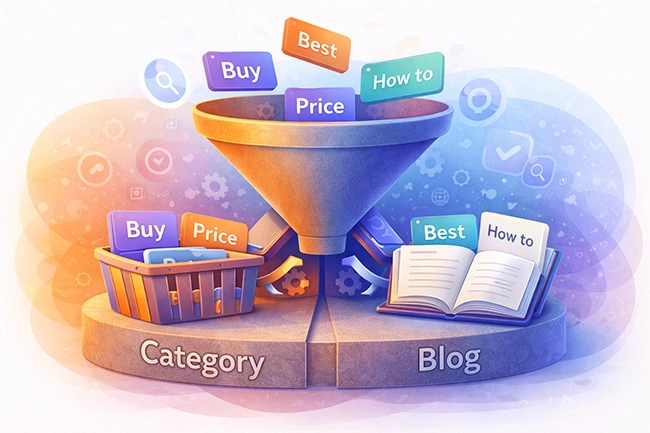
- Buy, shop, price, sale: usually a category page.
- Best, top, review, vs, comparison: usually a guide or review article.
- How to, why, what is, benefits: usually a blog post or help content.
- Brand + product type (for example, Nike running shoes): often a brand-focused category or filtered collection.
Category pages: the engine of buying decisions
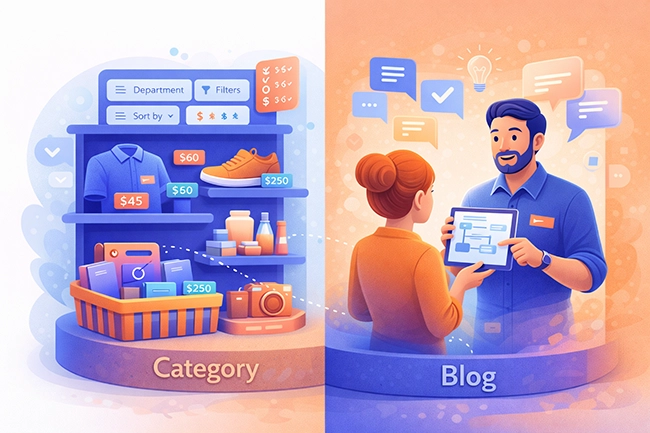
A category page is the digital version of a store aisle. People come here to scan, filter, compare, and choose. That means the page wins when it is fast, visual, and structured for decision-making. Filters (faceted navigation), clear product tiles, trust signals, and an uncomplicated path to product pages matter more than literary talent.
Where categories often lose is not because Google dislikes them. It is because many category pages are thin. They show products, but provide almost no context. When that happens, a well-written blog post looks more relevant to a crawler. The fix is not to turn your category into a novel. It is to add just enough context to remove ambiguity: what the category covers, what to look for, and how to narrow choices.
A practical rule: keep the product grid as the main experience, then add supporting text and FAQs lower on the page. This keeps shoppers happy and gives search engines the semantic clarity they need. The goal is not to impress an algorithm. The goal is to make it obvious that this is the best destination for someone ready to browse products.
Blog posts: the engine of discovery and trust
A blog post is closer to a sales associate than a shelf. It reduces uncertainty: how to choose, what to avoid, what matters for different use cases. It also captures long-tail queries that do not fit neatly into a category tree. You do not want a separate category for every micro-scenario a person might search.
Blogs are also natural link magnets. Other websites are far more willing to link to a useful guide than to a commercial product grid. That makes blogs a powerful way to earn authority, then pass it internally to your money pages. The irony is that the better your guide performs, the more likely it is to start competing with your own categories if you do not set boundaries.
What keyword cannibalization looks like on a real store
Cannibalization is not two pages rank for the same keyword. It is when two pages fight for the same intent and neither becomes a stable winner. The most damaging symptom is rank flipping: one week the blog ranks, the next week the category ranks, then the blog returns. Google is effectively saying: we know your domain is relevant, but we are not sure which URL is the best answer.
Hypothetical example (the pattern is common): a store publishes a guide called “Best wireless earbuds” and it climbs fast. Soon it starts ranking not only for best queries, but also for the broad head term “wireless earbuds”. Traffic rises, but the conversion rate drops because people who wanted a grid of products land on a wall of text, skim, and leave. Meanwhile the category page loses impressions, so you cannot easily fix conversion with merchandising tweaks because fewer shoppers reach the page in the first place.
How to diagnose the conflict quickly
You do not need a complicated tool stack to spot the problem. Start with Google Search Console: look at a query that matters, then check the Pages report. If impressions are split across two URLs with meaningful volume, that is your conflict zone.
A second quick check is a simple site search: type site:yourdomain.com plus the core phrase. If Google surfaces the blog above the category for a transactional term, it is treating the blog as the stronger answer. That does not mean the blog is wrong. It means the category is not sending a stronger signal for the intent you want.
Fixing it without breaking what already works
Most fixes come down to one principle: pick a primary page for a topic and give every other page a supporting job. The cleanest outcomes happen when each page has a distinct purpose in the customer journey.
Three remediation patterns cover most ecommerce situations:
- Consolidate: merge overlapping content into the stronger URL, then redirect the weaker one.
- Differentiate: keep both pages, but sharpen their intent signals so they rank for different query sets.
- Prune or de-index: remove pages that add little value yet compete (tag archives and thin variants are frequent culprits).
Consolidation works when a blog post is basically a thin product list in disguise. Move any genuinely helpful copy into the category page, keep the category as the main target, and redirect the blog. Differentiation works when both pages are legitimately useful, such as a broad category and a best-of guide. In that case, the blog should lean into comparison intent, while the category owns the head term.
Internal links are your vote. If every time you mention the core product term you link to two different URLs, you are voting for a tie. If you consistently link the head term to the category, and use more descriptive anchors for the guide, you are training both users and crawlers to follow a predictable path.
A practical anchor text example:
Let’s say you have a category for “Running Shoes” and a guide on “How to Choose Running Shoes.”
- When linking to the Category Page: Use the shortest, broadest nouns. You are signaling “this is the thing itself.”
- Correct anchors: “running shoes”, “mens running shoes”, “shop our collection”, “trail running footwear”.
- When linking to the Blog Post: Use descriptive phrases, questions, or qualifiers. You are signaling “this is information about the thing.”
- Correct anchors: “guide to running shoes”, “how to choose the best pair”, “running shoe reviews”, “what to look for in 2026”.
This semantic discipline stops the internal competition before it starts.
How to prevent cannibalization as you publish
Prevention is less glamorous than a rescue mission, but it is cheaper. The simplest governance system is a keyword map: each major topic gets one primary URL, and new content is planned around supporting that URL rather than replacing it.
This is also where ecommerce teams benefit from agreeing on taxonomy early. If you create categories based on how people shop, your content can focus on how people choose. When content starts targeting the same generic head terms as categories, you get internal competition. When it targets the questions people ask before buying, you get lift across the whole funnel.
What changes in the era of AI answers
AI-generated answers in search push many generic informational pages further down the results. That is not a reason to abandon content. It is a reason to make content more specific, experience-based, and connected to real product decisions.
Category pages remain resilient because even the best AI summary cannot replace the practical act of browsing inventory, filtering options, checking prices, and confirming availability. In other words: AI can answer questions, but it still cannot be your product grid. If your categories are strong, they keep their seat at the table.
Conclusion: clarity beats volume
The blog vs category conflict is rarely about which team did it wrong. It is a structural problem: one topic, two URLs, and mixed signals. Once you make intent the deciding factor, the solution becomes simpler: pick one primary page per topic, strengthen it for the dominant intent, and make every other page support it.
If you want a second set of eyes on your page roles, internal linking, and the places where you are unintentionally splitting demand, Advantrise can help. We work with ecommerce brands on SEO and PPC as a long-term growth system, not as disconnected experiments. For next steps, you can reach us here.
Subscribe to our newsletter