content
The undo button is more than 50 years old. The first undo commands appeared in research computer systems in the late 1960s and early 1970s, and ever since, any experiment on screen has cost one second. Make a mistake, press the keys, forget about it.
That button also holds up vibe coding. The term was coined by Andrej Karpathy, one of the co-founders of OpenAI, in February 2025. “There’s a new kind of coding I call ‘vibe coding’, where you fully give in to the vibes, embrace exponentials, and forget that the code even exists,” he wrote on X.
A few sentences later, Karpathy added that “it’s not too bad for throwaway weekend projects, but still quite amusing”. That part gets quoted far less often.
In November 2025, Collins named “vibe coding” its word of the year, and the word “vibe” moved into marketing. Vibe marketing now covers everything from website copy to Google Ads campaigns. The second half of the quote got lost along the way.
Let’s put the fine print back and walk through the channels an online store’s marketing is made of, from ads to bots on the website and in job interviews, measuring in each one how far it is to Ctrl+Z.
Google Ads does the vibing for you
In Google Ads you don’t even have to switch the vibe on. Google has long offered to do part of the advertiser’s work, and in May 2025 Search campaigns got AI Max.
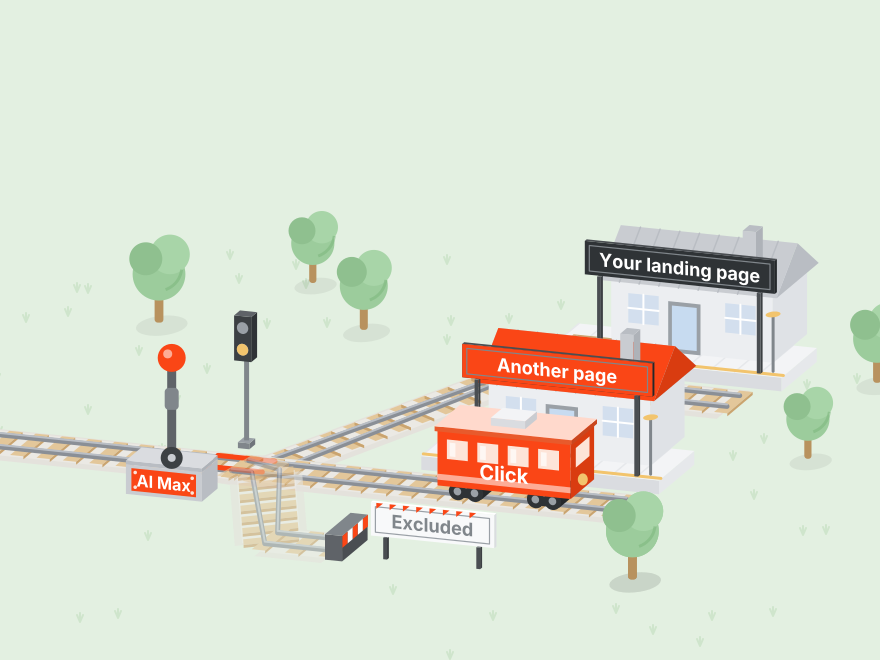
In AI Max for Search, Google writes ad copy itself, broadens the range of search queries it matches and picks the page of the website a visitor lands on.
The copy comes from text customisation, which builds headlines and descriptions from your website. The page is chosen by final URL expansion, which decides where a person goes after the click.
According to the Google Ads help centre, final URL expansion is switched on by default when you turn on AI Max.
Does it work? According to internal data Google cited in the announcement, advertisers using AI Max typically see 14% more conversions or conversion value at a similar CPA or ROAS. The figure comes from the tool’s seller, but the logic holds. In advertising, the vibe is saved by fast feedback, because conversions often show within a few days.
The weak spot is that Google chooses on its own and the advertiser sees the result after the fact. Google offers URL exclusions, which means it admits a business may need to keep some pages away from the algorithm. Set them up before launch.
The seasonality adjustment, another vibe setting that does more harm than good before a sale, is covered in our Black Friday article.
With AI Max, Google picks the ad copy and the landing page. Check search terms and the pages your money went to at least once a week. Ctrl+Z is one second away here, but it only reverts the settings, and spent budget stays spent.
Meta redraws your product without you
On Facebook and Instagram, AI can write the copy, and it can also repaint the picture.
In June 2026, REI, the US outdoor retailer, found a bike with two sets of handlebars in its Instagram ad. The second set grew out of the saddle. The company explained that Meta had automatically enrolled it in an AI personalisation tool, which altered a supplier’s photo inaccurately and inappropriately.
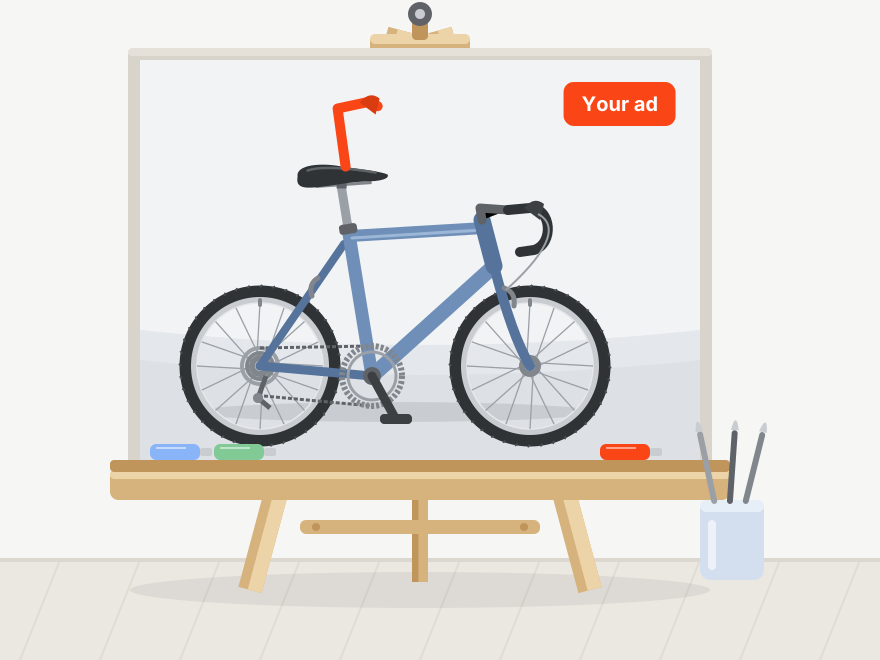
REI replied that a two-handlebar bike might be interesting, but it’s not something you’ll find in its range.
REI is not alone. Advertisers and agencies told Business Insider that Meta’s AI tools had suggested turning one advertiser’s pyjama dress into a shirt and trousers, and showing men in ads for a women’s business club. Several more advertisers complained about bugs that switched on AI features that were off by default.
As the WSJ reported in 2025, Meta wants to let brands create and target ads entirely with AI.
Here the platform tried to write the fine print itself. Meta’s updated commercial terms, as Adweek reported, were set to make the advertiser solely responsible from 30 October 2026 for everything Meta’s AI features create or change, even if the advertiser never switched them on. After a wave of criticism, Meta first moved the date to 20 November, then paused the update on 5 November. It has not named a new date (as of 23 November 2026).
Meta’s current terms for generative AI already make the advertiser responsible for reviewing everything AI produces.
For backgrounds, formats and copy variations, automatic creative makes sense. The exact look of a product is best left to someone who has seen it in person.
Meta can already change your product in a photo, and it leaves the responsibility for the result with you. After every update, check which AI features are on in your campaigns. You can stop an ad in a minute, but Ctrl+Z won’t take back a screenshot of a bike with two handlebars.
SEO and 1,800 pages in an evening
In late 2023, marketer Jake Ward boasted on X about an “SEO heist”. His team took a competitor’s sitemap of Excel tutorials for a client, the startup Causal, and, by Ward’s account, published 1,800 AI articles on the same topics in a matter of hours. He claimed 3.6 million “stolen” visits over 18 months.
According to Ahrefs estimates cited by Business Insider, Causal’s traffic did shoot up to more than 600,000 visits a week in October 2023. By mid-December it had dropped to around 190,000.
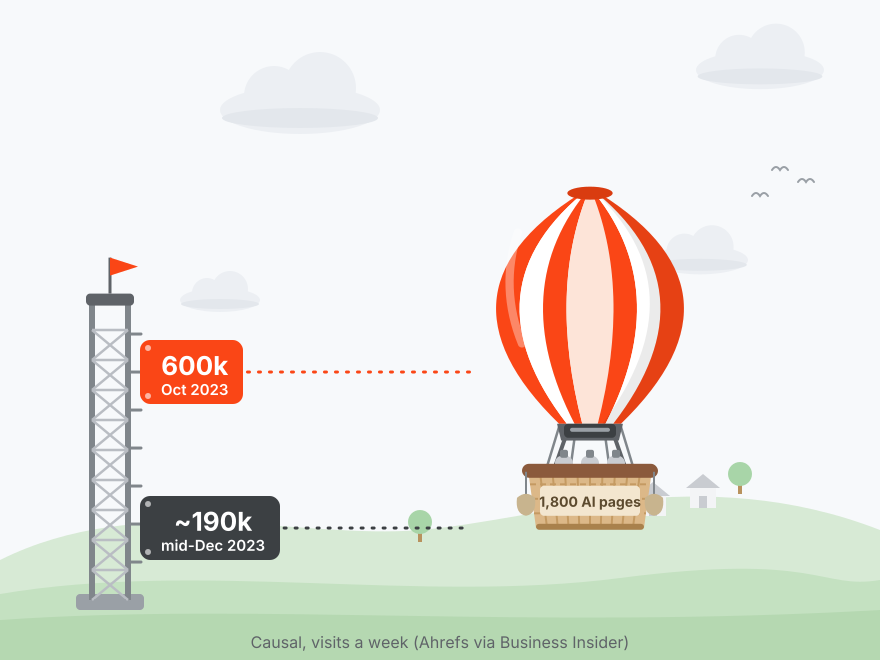
Google doesn’t comment on individual sites, so the reasons are anyone’s guess.
Search tolerates the vibe longer than anyone, and remembers it longer too.
Google set out its position back in February 2023. “Appropriate use of AI or automation is not against our guidelines,” wrote Danny Sullivan and Chris Nelson on behalf of the Search Quality team. The same post has a second half, which says that using automation, including AI, to generate content with the primary purpose of manipulating rankings violates spam policies.
An Ahrefs study fits the first half. In July 2025 the company analysed around 600,000 pages from the top 20 search results and found traces of AI on 86.5% of them. The correlation between the share of AI text and ranking was 0.011, which means there is practically no link.
Ahrefs uses its own detector and sells AI tools, so take the numbers with a grain of salt.
In March 2024, Google strengthened the second half with a dedicated policy on scaled content abuse. It covers large volumes of unoriginal pages made mainly to manipulate rankings with no value for people, “no matter how it’s created”.
In October 2026, Google added a separate instruction to its generative AI guidance. “It is critical to manually factcheck and review all AI-generated content,” the guidance now says, and this applies even to title tags, meta descriptions, structured data and alt text.
That sentence is a good place to bury a favourite dogma, the idea that a site grows from page count alone. After the Causal story, betting on it is risky at best, and it belongs among the relics of the digital landfill. In ecommerce SEO, AI writes good drafts of descriptions, meta tags and markup, as long as someone reads every page afterwards.
Google doesn’t care who wrote the text, as long as the page is useful to people. In SEO, Ctrl+Z is measured in months, because Google itself warns that recovery after an algorithm update can take several months.
The bot speaks for the company
The DPD bot that swore at a customer and the Chevrolet dealer bot that “sold” an SUV for $1 became memes long ago. Air Canada’s bot cost more. It assured a customer whose grandmother had died that the bereavement fare could be claimed after the flight, even though the airline’s rules ruled that out.
Before the British Columbia tribunal, Air Canada argued that it was not responsible for what its bot said.
“In effect, Air Canada suggests the chatbot is a separate legal entity that is responsible for its own actions. This is a remarkable submission,” wrote tribunal member Christopher Rivers in the decision. The customer received CA$812 including interest and fees.
The bot in a job interview now speaks for the company too. According to a Greenhouse survey from May 2026, 63% of US job seekers have already had an interview with AI. 70% of them were not clearly told beforehand, and 38% have walked away from a hiring process that included one.
The first viral glitch came in May 2025. Startup Apriora’s AI recruiter, interviewing a candidate for a Pilates studio, repeated “vertical bar pilates” 14 times in a row.
“I thought it was really creepy and I was freaked out,” the candidate told 404 Media. The TikTok video passed 2 million views, and Apriora never responded to the press.
Then candidates started breaking AI interviewers on purpose. In November 2026, TikToker Nick Reid joined a video interview with a sneaker on his head, and the avatar, called Karen, introduced herself as a Burger King recruiter.
“Why on Earth do you have a shoe on your head?” Karen asked. “Yeah. I have feet,” Reid replied.
According to Fast Company, the clip got nearly 8 million views, and Karen’s face spread as a meme. No one has confirmed the clip is genuine, but the chain still had to answer for it. “We do not use, nor are we aware of any Franchisee across the U.S. or Canada using a tool like this,” Burger King said.
A job interview is marketing too, only for future staff. A candidate interrupted by a bot tells friends about it, and sometimes a few million viewers.
A bot on the website or in an interview speaks for the company, and the Air Canada case made that a legal fact. Trust a bot with delivery updates and interview scheduling, and leave money, rules and judging people to people. The tribunal decision took more than a year, the Karen clip spread in a few days, and no button undid either.
When Ctrl+Z turns into a fine
A fake review and a bot that doesn’t say it’s a bot sit side by side in law. Both mislead a person about who they’re dealing with.
In the EU, fake reviews have been banned since 28 May 2022, when amendments to the unfair commercial practices rules took effect. A store that shows reviews has to explain how it checks they come from real customers.
Since 2 August 2026, Article 50 of the AI Act also applies there. A bot has to disclose that it’s a bot unless that’s obvious from the context, and a deepfake has to be labelled as artificially generated or manipulated.
In the US, the FTC rule on fake reviews and testimonials has been in force since 21 October 2024. In its press release the regulator singled out reviews by people who don’t exist, “such as AI-generated fake reviews”. For knowing violations, the FTC can now seek civil penalties.
“Fake reviews not only waste people’s time and money, but also pollute the marketplace and divert business away from honest competitors,” said then FTC Chair Lina Khan.
The law does exactly what Air Canada tried to avoid. It makes a brand own the voice in the chat.
AI can write replies to real reviews, but not the reviews themselves. And label your bot as a bot. There is no Ctrl+Z here at all, a fine comes instead.
What Karpathy wrote in the fine print
In October 2025, Karpathy released nanochat, his teaching project, and someone asked how much of the code he wrote himself.
“It’s basically entirely hand-written (with tab autocomplete). I tried to use claude/codex agents a few times but they just didn’t work well enough at all and net unhelpful, possibly the repo is too far off the data distribution,” he replied.
nanochat was no weekend project, and the man who gave the vibe its name didn’t switch it on here.
Within 3 months the agents caught up, and in January 2026 Karpathy wrote that he had gone from about 80% hand-written code to 80% agent code. The fine print stayed. If the code matters to you, you should “watch them like a hawk”, he added.
In April 2026, Karpathy split the terms for good. “Vibe coding is fine for prototypes and personal tools. Agentic engineering is what serious teams need,” he wrote on his blog.
It seems the man who coined the term is the only one who always reads his own fine print.
| Channel | Where the vibe fits | Where a person is needed | How far to Ctrl+Z |
|---|---|---|---|
| Google Ads | New queries and copy variations | Search terms and final URLs | A second for settings, budget doesn’t come back |
| Meta | Backgrounds, formats, copy variations | Product photos | A minute for the ad, the screenshot stays |
| SEO | Drafts of descriptions, meta tags, markup | Facts and the final read | Months |
| Bots on the site and in HR | Order status, interview scheduling | Money, rules, judging candidates | A tribunal decision or a viral clip |
| Reviews and the law | Replies to real reviews | The reviews themselves and labelling the bot | A fine |
If you’re ready to sign off on the result without reading it, vibe away. If your hand reaches to reread it, that’s where a person is needed.
What to expect from the vibe in 2027
There will be more vibe even for those who never switched it on. In February 2027, Google will automatically move Dynamic Search Ads (DSA) campaigns that advertisers haven’t migrated themselves to AI Max. Text customisation and final URL expansion will switch on along with it.
The fine print will grow too. From 1 January 2027, California will bar companies with annual revenue above $500 million from passing off a support bot as a human, and customers will get the right to reach a live agent. Ads featuring AI “synthetic performers” will need a label there from the same day.
In the EU, 2027 will be the first full year of Article 50 of the AI Act. And from 2 December 2027, requirements for AI used in hiring, which the law classes as high risk, start to apply there. Interview bots fall right into that category.
In Australia, from 10 December 2026, organisations have to explain in their privacy policy where computer programs, including generative AI, make decisions that significantly affect people.
Meta’s terms, which would have made advertisers answer for everything its AI makes, are on pause for now. The question of who answers for the two-handlebar bike has only been put off.
In 2027, platforms will switch on even more AI by default, and laws will ask for even more signatures under the result. You’ll need to check more often than before.
February is close, so don’t wait for Google to move your campaigns for you. Get in touch with Advantrise, and we’ll check which AI settings are already on in Google Ads and Meta and what search engines see on your pages.
Vibe marketing FAQ
What is vibe marketing?
It’s marketing where a person sets the task and AI produces the copy, creative and settings. The name comes from vibe coding, a term Andrej Karpathy coined in February 2025, which Collins named its word of the year in November 2025.
Does Google penalise AI-written content?
Not if the content is useful. Since 2023, Google has said that appropriate use of AI is not against its guidelines, and Ahrefs found traces of AI on 86.5% of top 20 pages. Scaled content with no value gets penalised, and since October 2026 Google’s guidance has insisted that facts in everything AI creates must be checked by hand.
Should you turn on AI Max in Google Ads?
Test it, but not blindly. According to Google, advertisers using AI Max typically see 14% more conversions or conversion value at a similar CPA or ROAS. Final URL expansion switches on with it by default, so check search terms and landing pages regularly. Google will move DSA campaigns to AI Max automatically in February 2027.
Who is responsible for what a website chatbot says?
The company. In the Air Canada case, the British Columbia tribunal found that the chatbot is part of the airline’s website and ordered it to compensate the customer for the bot’s wrong answer.
Can you generate reviews with AI?
Not fake ones. In the EU they have been banned since May 2022, and in the US the FTC rule has banned reviews by people who don’t exist, including AI-generated ones, since October 2024, with civil penalties for knowing violations. AI can be used to reply to real customer reviews.
Subscribe to our newsletter